Why Am I Not Hearing Back From Jobs? A 2026 Diagnosis
The causes of the silence, ranked by how much they actually explain, and marked by which ones you can move.
Mostly because the line got longer and the door got narrower. Applications per opening roughly doubled between 2021 and 2025 while the hiring rate fell from 4.5% to 2.8%, and 62% of filled roles now go to an internal candidate. Silence is usually a decision that was made and never mailed, not a verdict on you.
The question under the question
You are not really asking a research question. Six weeks into the silence, at an hour when nothing looks good, you are asking whether something is wrong with you. So take the honest answer first: almost none of the silence is about you, and the small part that is can be named precisely.
The useful move is to rank the causes by how much they actually explain, not by how fixable they feel. Most job search advice does the opposite, because the fixable causes are the ones somebody can sell you a solution for.
| What is producing the silence | How much it explains | Can you move it? |
|---|---|---|
| Applicant volume per opening | Most of it | Only by choosing where you apply |
| Roles filled from inside the company | A large share | Only through referrals and introductions |
| Postings with no live decision behind them | Some | Yes, by vetting a listing before you apply |
| Rejections that were decided but never sent | Some | No |
| A process that is simply slow | Some, in the first two weeks | No, only how long you wait |
| Targeting and experience fit | Least, but real | Yes, and this is where your effort pays |
The rest of this piece works down that list in order. The last row is the shortest section, and it is deliberately last.
The line roughly doubled
Start with the number that explains more of your silence than everything else on the list combined. Applicants per job posting nearly doubled between 2021 and 2025, from about 46 to 95, across an analysis of 72 million applications and more than a million postings (BambooHR, 2026).
Nothing about you changed between those two years. The queue you are standing in did.
Now put the other half of the fraction beside it. Over the same period the hiring rate, measured as monthly hires against total employees, fell from 4.5% to 2.8%, and completed hires dropped from 1.34 million to 1.05 million even as the employee population in the dataset grew from 30.8 million to 37.5 million. Job postings held roughly steady the whole time. More people applying, fewer people hired, the same number of doors.
One line in the same analysis kills the obvious counter-argument. Offer acceptance rates held in the mid-to-upper 70% range across all five years. Candidates are not refusing the jobs. The narrowing happens long before an offer is ever written.
Job seekers can feel this without seeing the data. Among people currently looking, 68% expect this search to take longer than their last one, and 59% name competition and applicant volume as the reason (Robert Half, 2025).
Most roles are filled from inside
Here is the cause almost nobody explains to applicants, and it may be the most important thing on this page.
Internal mobility accounted for 51% of all filled roles in 2021. By 2025 the figure was 62%, and it rose every single year in between (BambooHR, 2026).
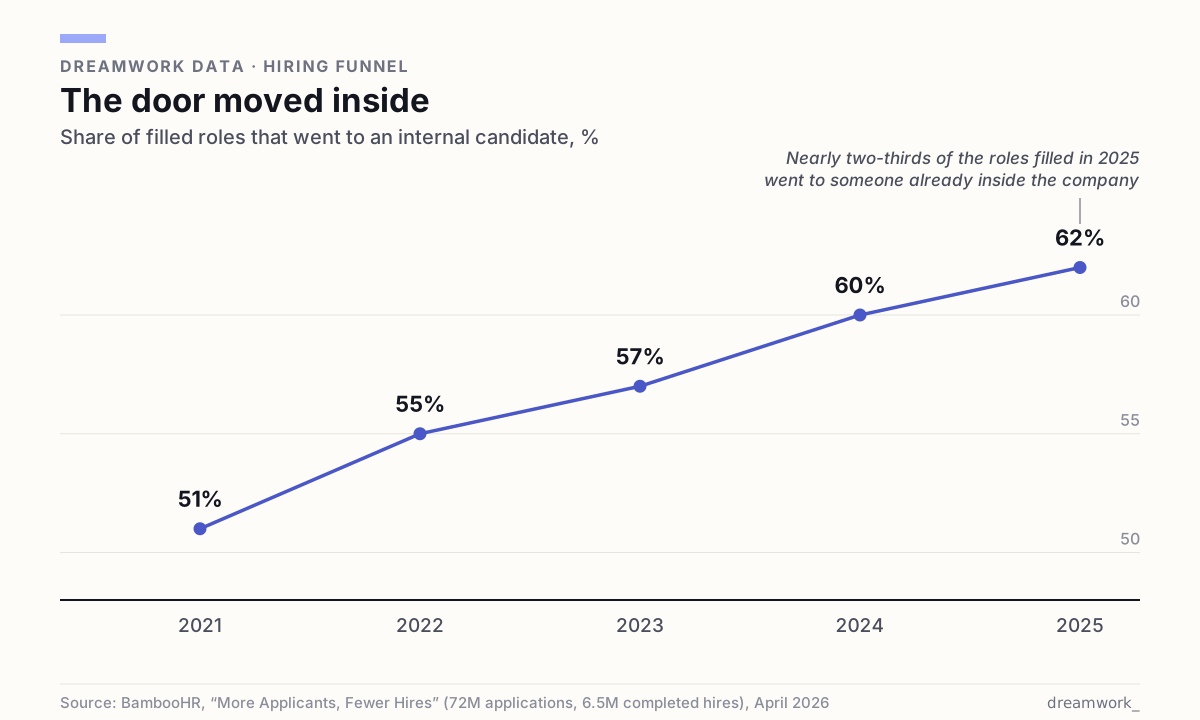
Read that slowly. Close to two-thirds of the roles that actually got filled went to somebody who already worked there. The posting was real. The interviews were real. For a large share of those roles, the external pipeline was running alongside a decision that already had a head start.
This is why the silence feels so total, and why so many people describe getting deep into a process and then hearing nothing at all. You were not only competing against the other applicants. You were competing against the org chart, which nobody put in the job description.
It also tells you where your hours are worth the most. Referrals get dismissed as a networking cliche. They are also the only ordinary mechanism that moves you from the outside queue toward the inside one.
Some postings had no live decision behind them
A share of your applications went to roles nobody was actively filling.
Across 176,268 job listings collected from 49 industries and every U.S. state in February 2026, about one in seven had been active for more than 30 days, and 4% had been live for four months or longer (Clarify Capital, 2026). In wholesale it was 51% of postings. Among senior-level listings, 21%.
A stale posting is not automatically a fake one. It can be an evergreen requisition, a pipeline builder, or a search that quietly stalled when a budget moved. From your side of the screen the distinction barely matters: you applied to something with no live decision behind it, so there was nothing there to hear back from. Our guide to ghost jobs covers how to read a listing before you spend an evening on it.
The rejection was never mailed
Some of the silence is not indecision at all. Somebody already decided, and then nobody wrote.
In a survey of 1,066 U.S. job seekers, 50.5% had received a rejection with no human feedback whatsoever in the previous 12 months, and 63.8% of those people believed a machine had made the call (Enhancv, 2026).
The stage where the silence begins is the real tell. Asked when an employer had gone quiet on them, the most common answer job seekers gave was the very first step, right after the application was submitted (iHire, 2025).
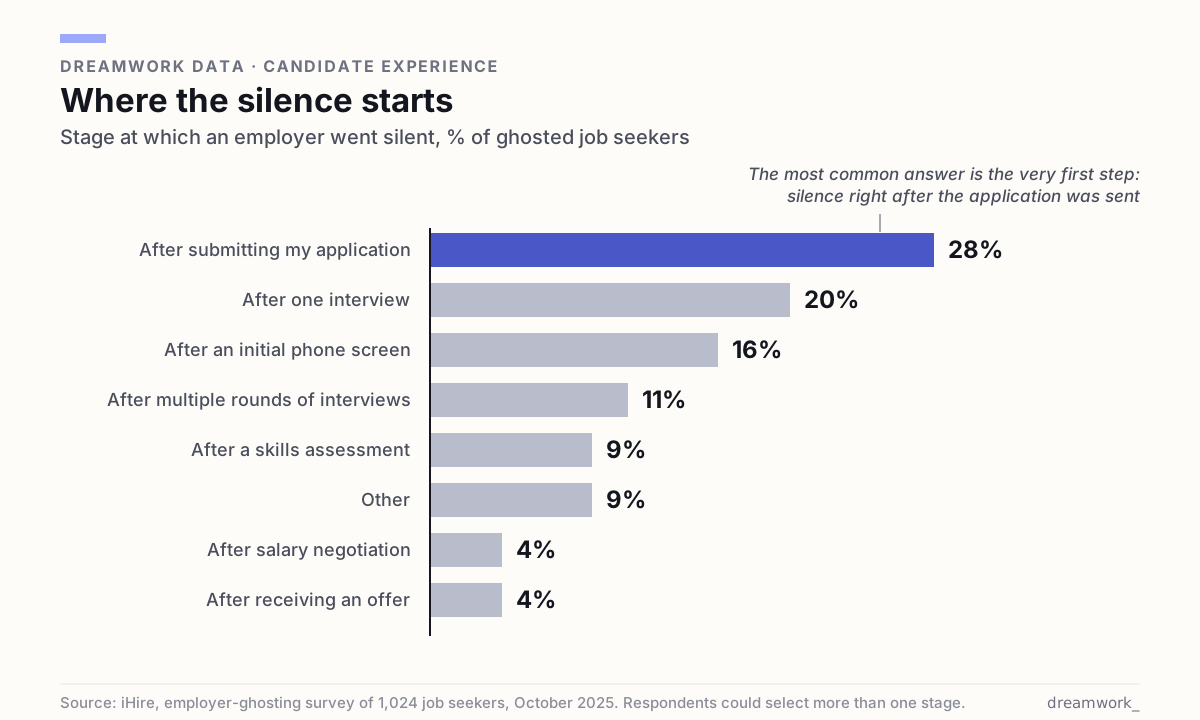
Nothing in that chart is a statement about your qualifications. It describes a communication step that costs an employer something and buys them nothing. When one opening draws 95 applications, writing 94 rejection notes is real work, so most of them never get written.
The cause everyone repeats that has no source
Somewhere in week three, someone will tell you that 80% of jobs are never advertised, so the silence is your own fault for using job boards. It is worth knowing where that number came from.
It traces to a 1966 article by Bernard Haldane citing a pilot survey run in Rochester, New York. The figure held there because the large local manufacturers had agreed to route hiring through a shared placement service instead of newspaper advertising (Learning Curves, 2023). It described one city's arrangement sixty years ago. It has been repeated ever since as a law of the labor market.
Referrals do matter, for exactly the reason two sections up: most roles get filled from inside. But the advice built on that statistic tells you your search is failing because you are looking in the wrong place, when the evidence says you are looking in a place that got twice as crowded. Those two diagnoses lead to different weeks.
The part that is actually yours
Now the section you came for, and the one that should be smallest.
In a dataset of more than a million logged rejection decisions, 500,000 carried a specific reason a recruiter chose by hand, and roughly 91% of those were logged at the screening stage (Pin, 2026). Here is what they said.
| Reason a recruiter gave | Share of merit-based rejections |
|---|---|
| Not enough experience | 16.6% |
| Wrong type of role | 15.6% |
| Wrong industry background | 14.2% |
| Overqualified | 12.2% |
| Not qualified for the role | 12.0% |
| Missing required skills | 10.6% |
| Wrong location | 3.7% |
Three things fall out of that list. Wrong type of role and wrong industry background together account for 29.8%, and that is targeting, which is entirely yours to change. Experience calibration is comparable at 28.8%, but note the direction: being overqualified gets people rejected more often than being formally unqualified, so applying below your level is not the safe fallback it looks like. And wrong location, the thing applicants agonize over, is 3.7%.
Notice what does not appear on the list at all: fonts, margins, and a mythical machine score. Your resume still has to come apart cleanly on the other end, which our machine-readable resume guide covers, and our explainer on applicant tracking systems covers what that software genuinely does. Both are hygiene. Targeting is the thing that moves the number.
One more honest fixable: volume degrades quality. Past roughly 80 applications, offer rates fall rather than rise, which we work through in how many applications it actually takes. If you are sending more and hearing less, those two facts are related.
What to do with the silence
Put the causes back in order. The queue roughly doubled. Most filled roles went to insiders. A share of the postings had no live decision behind them. Half of job seekers got a rejection nobody bothered to write. Underneath all of that sits a smaller, genuinely fixable layer: whether you are applying to the right type of role, in the right industry, at roughly the right level.
That ordering has a practical consequence. Spend this week rewriting your resume for the fifth time and you are working the bottom row of the table. Spend it narrowing what you apply to, and finding one person inside a company who will pass your name along, and you are working the rows that actually explain the silence.
Then set the clock honestly. Replies that come tend to come fast, mostly inside two weeks, which our timing guide lays out with the data. After that, waiting stops being patience and starts being cost. Close the tab and put the hour into the next application or the next introduction. If you want roles ordered by fit rather than by who paid to be seen, that is what AI job search is for, and our live job index and how-to guides are a reasonable place to start.
You asked whether something is wrong with you. Ninety-five people applied to that job, nearly two-thirds of the roles that got filled last year went to someone already inside, and nobody wrote to tell you either of those things. That is not a verdict. It is a funnel, and you happened to be standing in it.
Frequently asked questions
Why am I not hearing back from jobs?
Mostly because of applicant volume and internal hiring, not because of your resume. Applicants per job posting nearly doubled between 2021 and 2025, from about 46 to 95, while the hiring rate fell from 4.5% to 2.8% (BambooHR, 2026). Over the same period the share of roles filled by an internal candidate reached 62%, so most openings closed without an outside applicant winning.
Does no response mean I was rejected?
Usually yes, and the rejection was simply never sent. In a survey of 1,066 U.S. job seekers, 50.5% had received a rejection with no human feedback at all in the past year (Enhancv, 2026), and the most common point at which employers go quiet is right after the application is submitted (iHire, 2025). Skipping the email costs an employer nothing, so most skip it.
How many people am I competing with for one job?
About 95 applicants per posting on average in 2025, up from roughly 46 in 2021 (BambooHR, 2026). That is an average across industries and company sizes, and it is not evenly spread: large employers took 46% of all applications in 2025, up from 41% in 2021, while the share going to employers with fewer than 25 people fell from 21% to 15%.
Is it my resume or is it the job market?
It is mostly the market, and the part that is yours is targeting rather than formatting. Across 500,000 recruiter-logged screening rejections, wrong type of role and wrong industry background together accounted for 29.8%, while wrong location accounted for 3.7% (Pin, 2026). Fonts and margins are hygiene; whether you are applying to the right kind of job is the decision that moves your reply rate.
Why do I get rejected for being overqualified?
Because too much experience is one of the most common rejection reasons there is. In 500,000 recruiter-logged screening decisions, 12.2% of rejections were for being overqualified, slightly ahead of the 12.0% marked simply not qualified (Pin, 2026). Applying below your level is not the safe fallback it looks like, and it is worth naming your reasons for the step down in the application itself.
Is it true that 80% of jobs are never advertised?
No, not as a general fact about the labor market. The figure traces to a 1966 article citing a pilot survey in Rochester, New York, where large local manufacturers had agreed to hire through a shared placement service rather than newspaper ads (Learning Curves, 2023). It described one city's arrangement, and it has been repeated for sixty years without that context.
Sources
- BambooHR, April 2026: More Applicants, Fewer Hires, New Data Explains the 2026 Hiring Slowdown (72M applications, 1M+ postings, 6.5M hires; applicants per posting, hiring rate, internal mobility)
- Clarify Capital, February 2026: Ghost Jobs Are Haunting the U.S. Job Market (176,268 listings, 49 industries; one in seven active 30+ days)
- Enhancv, April 2026: AI Hiring in 2026 (survey of 1,066 U.S. job seekers; 50.5% rejected with zero human feedback, 63.8% believed a machine decided)
- iHire, October 2025: 53% of Job Seekers Have Been Ghosted by a Potential Employer (survey of 1,024 job seekers; stage-by-stage breakdown)
- Robert Half, November 2025: Nearly 4 in 10 Professionals Plan to Search for a New Job in 2026 (2,000+ employed workers and 450+ job seekers; 68% expect a longer search)
- Pin, July 2026: Top 10 Candidate Rejection Reasons in 2026 (1M+ logged rejection decisions, 500K+ merit-based, February 2024 to June 2026)
- Learning Curves (Jesse Preston), July 2023: Hidden Origins of the Hidden Job Market, Part 2 (tracing the 80% statistic to a 1966 Rochester pilot survey)