What Is an Applicant Tracking System? (2026 Guide)
The software almost every employer uses — what it really does to your resume, and what actually helps.
An applicant tracking system, or ATS, is the hiring software almost every large employer uses to collect, store, and sort job applications. When you hit submit, your resume enters a searchable database, not a shredder. Nearly 98% of Fortune 500 companies run one. It rarely auto-rejects you outright — but it does make it cheap for a human to never look.
What an applicant tracking system actually is
Start with the acronym, because the mystery starts there. ATS stands for applicant tracking system. It is software that employers use to collect, store, sort, and move job applications through the stages of hiring. That is the whole of it. An applicant tracking system is, at its core, a database with a hiring workflow bolted on — a filing cabinet that learned to say no.
Here is what it is not. It is not an all-seeing artificial intelligence that reads your resume, judges your worth, and fires you into a void in under a second. That picture is mostly folklore, and it has cost job seekers a decade of misplaced panic. When you hit submit, your resume does not hit a shredder. It enters a searchable record that a recruiter can pull up, rank, tag, and eventually read.
The distinction matters because it changes what you should do about it. If the machine were an all-powerful robot judge, your only job would be to trick it. It isn't, so your job is different — and more winnable — than the panic industry wants you to believe.
Why nearly every large employer uses one
The adoption numbers are staggering, and they are not new. In 2025, an applicant tracking system was detected at 97.8% of Fortune 500 companies — 489 of the 500 (Jobscan). That share has hovered near 98% every year measured since 2018. Across large enterprises generally, adoption is near-universal, and the global market for this software runs into the billions of dollars a year. If you are applying to a company of any real size, assume there is an ATS between you and the hiring manager.
The reason is volume, not villainy. A single corporate opening now draws an average of 250 applications (Jobscan). Some roles pull thousands. No human can read 250 resumes for one job, across twenty open jobs, and still do anything else. So employers buy software to hold the pile and make it searchable. The system exists to manage the employer's flood — which means it is optimized for their throughput, not your fairness. Hold onto that sentence; the rest of this guide follows from it.
What really happens to your resume after you apply
Outcome first: here is what your application actually does. It lands in the employer's database as a structured record. The software reads the text and files your details — titles, dates, skills, education — into fields a recruiter can search. When the recruiter wants candidates, they search that database the way you would search anything, by the terms that match the role. Applications that line up with what they typed rise to the top. The rest sink.
Then a human takes over — far more often than the myth admits. Recruiters themselves estimate that 90–95% or more of all applications are reviewed by a person (via The Interview Guys). The catch is how fast. In a 2018 eye-tracking study, recruiters spent an average of 7.4 seconds on the first pass of a resume (Ladders, via HR Dive). Not seven minutes. Seven seconds. Your resume is rarely killed by a robot. It is skimmed by a busy person deciding, in about the time it takes to read this sentence, whether to keep reading.
So the real gate is not "did the software approve me?" It is "when a human searched, and skimmed for seven seconds, did I surface, and did I make sense?" Those are two very different problems, and only the second one is real.
The "75% of resumes get auto-rejected" myth
You have seen the number. "75% of resumes are rejected by the ATS before a human ever sees them." It is everywhere — resume blogs, career influencers, and tools that will happily sell you a fix. It is also, as far as anyone can document, made up.
The claim traces back to a 2012 sales pitch by a company called Preptel, which sold resume-optimization services. The company went out of business in 2013. No study, no survey, and no methodology was ever published behind the figure (The Interview Guys; career consultant Christine Assaf). Larger outlets repeated it, the already-missing sourcing fell away entirely, and it hardened into "fact" through sheer repetition. A number invented to sell a product became the reason people buy the product.
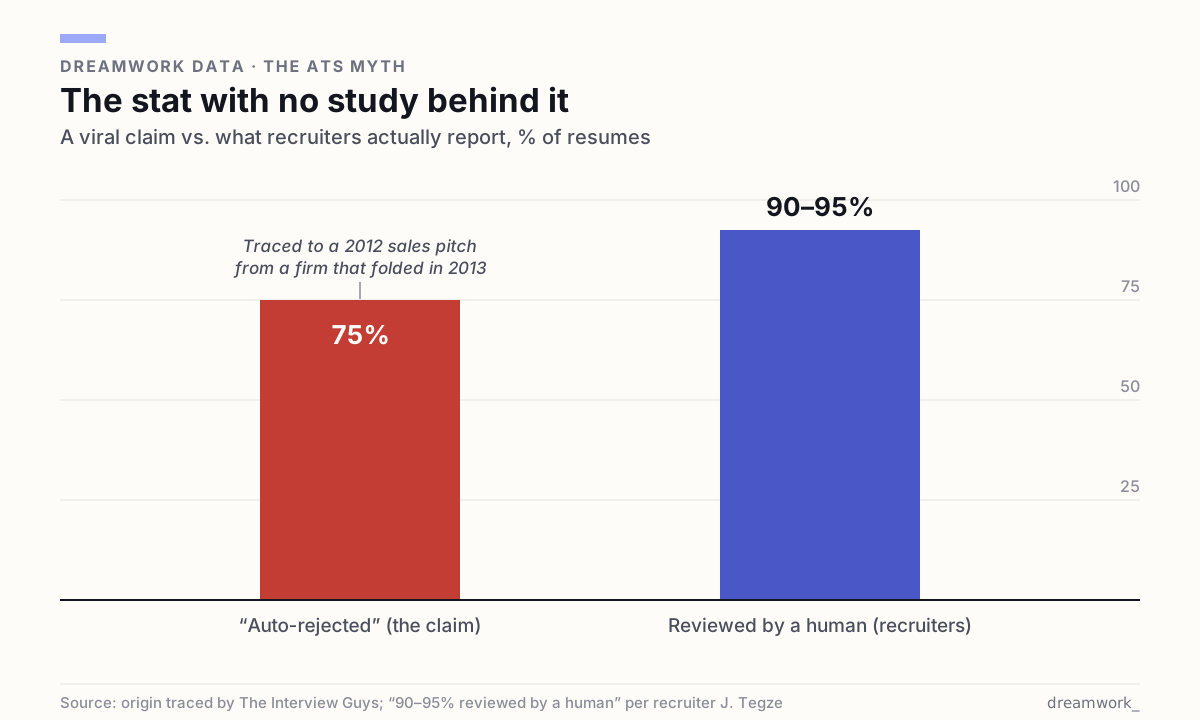
The honest version is less scary and more useful. Applicant tracking systems mostly organize and rank; they do not run a secret tribunal that deletes three of every four applicants on arrival. Recruiters who have actually used these systems tend to find the auto-rejection myth laughable. So treat any tool that leads with the 75% stat, or promises to beat a robot that mostly isn't judging you, with suspicion. It is selling a cure for a disease it invented.
The real problem: rigid filters, not robots
None of this means the system is harmless. It means the harm sits somewhere other than where the myth points. The damage is not a mystery algorithm — it is the rigid, human-set filters a recruiter switches on, and the seven-second skim that follows.
The most credible evidence comes from Harvard Business School and Accenture, whose 2021 Hidden Workers report surveyed thousands of employers. 88% of employers agreed that qualified, high-skilled candidates are screened out of the process because they don't exactly match the criteria in the job description. For middle-skilled roles, 94% said the same. These are not robots gone rogue. They are filters people chose: a hard degree requirement, a demand for one specific credential, an automatic cut for any employment gap over six months.
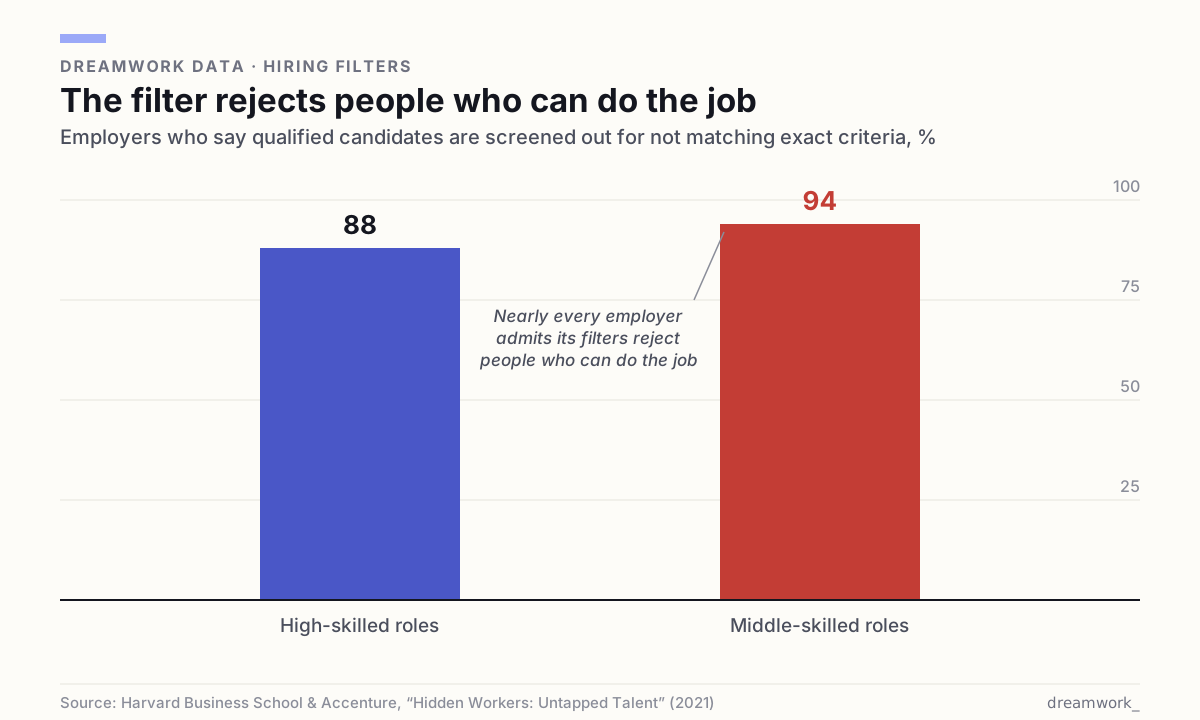
Read that as a worker, not a headline. The most common way to lose is not a formatting glitch. It is being genuinely able to do the job while missing one box someone decided was mandatory. The report calls the people this creates hidden workers — capable, available, and invisible because the process screens for what you lack instead of what you can do. That is the real machine. It is quieter and more ordinary than the robot of legend, and it turns away far more good people.
What genuinely helps (and what's snake oil)
If the software mostly sorts and a human mostly decides, the moves that help are unglamorous and real. In rough order of impact:
- Mirror the role's real language, honestly. If the posting asks for skills you actually have, name them the way the posting does. You are not tricking a robot; you are making sure you surface when a human searches, and read as a fit in seven seconds. Our ATS-friendly resume template is built for exactly this.
- Keep the format clean and legible. Clear headings, standard sections, no dense multi-column mazes — not because the software "can't read" anything fancy, but because both the database and the tired human get through a simple layout faster.
- Fix the real disqualifiers. Unexplained gaps, missing must-have credentials, and screening questions do more damage than any imagined algorithm. Address them directly instead of hoping a keyword hides them.
- Spend your effort upstream — on fit and referrals. A resume aimed at a role you genuinely fit beats a keyword-stuffed one aimed at a role you don't. And a referral routes you around the pile entirely.
And the snake oil: any product promising a magic "ATS score" or a guarantee to "beat the bots." There is no universal score. Different employers set up their software differently, search for different terms, and switch on different filters. A tool grading you against one imaginary standard is measuring nothing. The number it hands you is theater — reassuring, precise-looking, and disconnected from any actual employer's inbox.
Built for their throughput, not your fairness
Zoom out and the applicant tracking system is a small, honest window onto how modern hiring actually works. It was not built to be fair to you. It was built to make an unmanageable flood manageable for the employer — 250 applications per opening, filtered down to a shortlist someone can skim before lunch. Fairness was never the design goal. Efficiency was. Everything you experience as coldness is that priority, working as intended.
So stop applying like someone trying to outsmart a robot, and start applying like someone who understands the real game: surface honestly, read as a fit fast, clear the human-set filters, and pour your best energy into roles you actually match. Our guide to how many applications it takes to get a job shows why a few sharp applications beat a hundred sprayed ones, and Dreamwork's live job index is one place to find the roles worth that care. The software isn't your enemy. It's just not on your side. Once you know which, you can finally stop performing for it.
Frequently asked questions
What does ATS stand for?
ATS stands for applicant tracking system. It is the software employers use to collect, store, sort, and move job applications through hiring. Nearly 98% of Fortune 500 companies use one (Jobscan, 2025). When you apply online at a company of any size, your resume almost certainly lands in an ATS first.
How does an applicant tracking system work?
It stores your application as a searchable record, filing your titles, dates, skills, and education into fields. When a recruiter searches for candidates, applications that match the terms and filters they set rise to the top. A human then reviews the shortlist — recruiters estimate 90–95% of applications are seen by a person, though often for just seconds.
Do applicant tracking systems automatically reject resumes?
Rarely in the way people fear. The viral claim that 75% of resumes are auto-rejected traces to a 2012 sales pitch with no study behind it. Most applications are reviewed by a human. What does eliminate candidates is human-set filters — screening questions, hard credential requirements, and employment-gap cutoffs — not a secret algorithm.
What is an ATS-friendly resume?
One that surfaces when a recruiter searches and reads as a clear fit in a few seconds. That means mirroring the posting's real language for skills you genuinely have, using clean standard formatting and headings, and avoiding dense multi-column layouts. It is about legibility and honest matching, not tricking software.
Are "ATS score" checkers accurate?
No universal score exists. Employers set up their software differently, search different terms, and switch on different filters, so a tool grading you against one imaginary standard is measuring nothing real. Treat any product promising to "beat the bots" or hand you an ATS score as marketing, not measurement.
Why do so many employers use an ATS?
Volume. The average corporate opening draws about 250 applications, and some pull thousands (Jobscan). No team can read that by hand across many roles, so employers buy software to hold and search the pile. The system is optimized for their throughput, which is why it can feel indifferent to you.
Sources
- Jobscan — 2025 Applicant Tracking System (ATS) Usage Report (Fortune 500 adoption; 250 applicants per opening)
- The Interview Guys — The ATS Resume Rejection Myth (origin of the 75% claim; 90–95% reviewed by a human)
- Harvard Business School & Accenture — Hidden Workers: Untapped Talent (2021)
- HR Dive — Report: applicant tracking systems may exclude whole segments of candidates (88% / 94%)
- HR Dive — Eye-tracking study shows recruiters look at resumes for 7 seconds (Ladders, 2018)