How Long to Hear Back After Applying? (2026 Data)
The honest ranges, the full timeline, and the exact moment to stop refreshing your inbox and move on.
Employers who reply usually do so within one to two weeks: the median first response lands around 6 to 7 business days after you apply, and 44% of people who hear back do so within two weeks (Indeed). The hard part: roughly 75% of applications get no reply at all. If two weeks pass in silence, treat it as a soft no and move on.
The short answer to the question keeping you up
You hit submit three days ago. You have checked your email eleven times since. This is the most human part of the job search — the waiting — and it is also the part nobody gives you honest numbers for. So here they are, plainly, before the caveats: when an employer replies, the median wait is about 6 to 7 business days, and by the two-week mark 44% of the people who hear back already have (Indeed). Most real movement happens inside the first two weeks or not at all.
But there is a second number, and it is the one that actually explains your inbox. Around 75% of applications never get a reply of any kind (2025 Ghosting Index). Not a rejection. Not an automated no. Nothing. So the accurate answer to "how long does it take to hear back?" is really two answers at once: fast, if you hear back at all — and for three out of four applications, never.
What the data says about response time
Start with the good news, because there is some. When a reply does come, it comes quickly. A 2025 benchmark study of more than 1,000 U.S. job seekers, tracked over a 45-day window, found the median time to a first meaningful response was 6 to 7 business days — and the middle 50% of replies landed between 4.5 and 8.1 days (Careery / techrseries). Roughly a quarter of responses arrived by day 4 or 5. Three-quarters had arrived by day 8.
Indeed's own breakdown tells the same story from a different angle. Only 4% of applicants hear back within one day. 37% hear back within one week. 44% within two weeks. The curve is steep early and flat late — which is the single most useful fact in this entire guide.
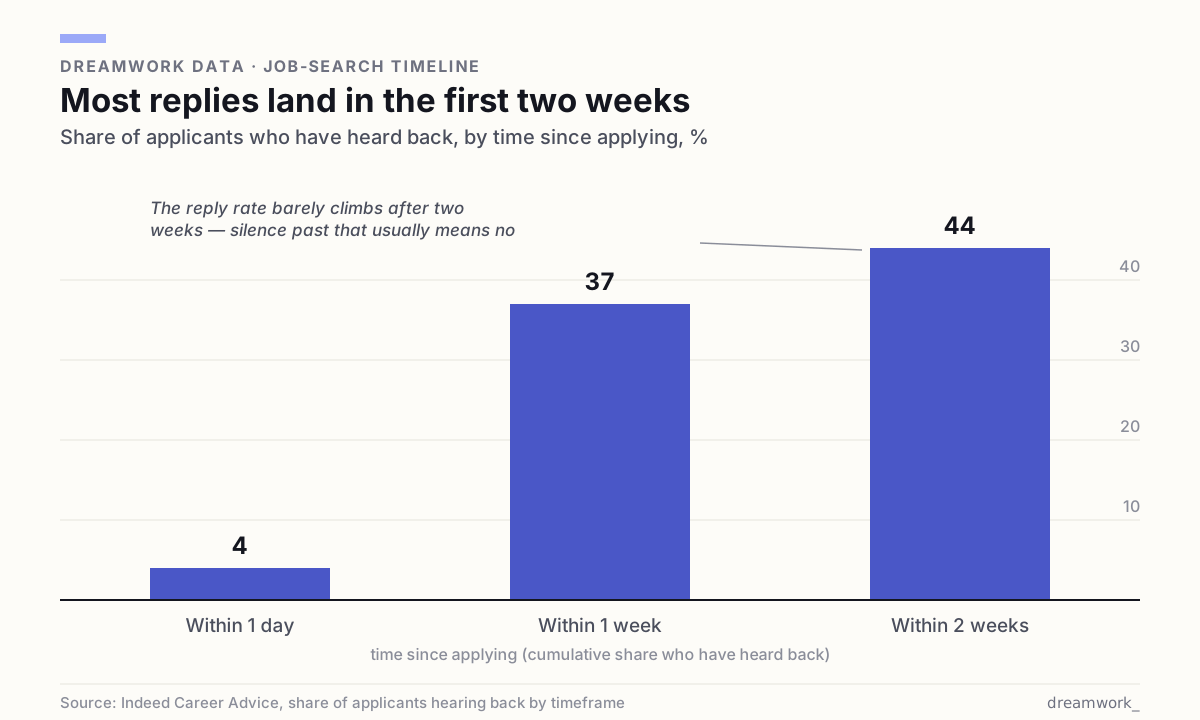
Notice what that flat tail means for you. If a reply were going to come, it very likely would have come by now. The study authors set their own cutoff at the same place the data points: applications with no response inside 45 days are statistically unlikely to ever produce one (Careery). You do not need to wait 45 days to act on that, though. The practical horizon is much shorter.
The part nobody puts in the headline
Every "median 6.7 days" statistic hides a denominator problem. That number describes only the applications that got a reply. It says nothing about the far larger pile that got nothing. And the pile that gets nothing is the majority.
The 2025 Ghosting Index, a synthesis of more than 50 recent studies, put it bluntly: roughly 75% of job applications receive zero response from an employer. The odds also swing hard by where you apply. Applications through large job boards see response rates around 20–25%; applications submitted straight into a company's own career site can run as low as 2–5%. Same resume, same person, a tenfold difference in whether anyone ever writes back.
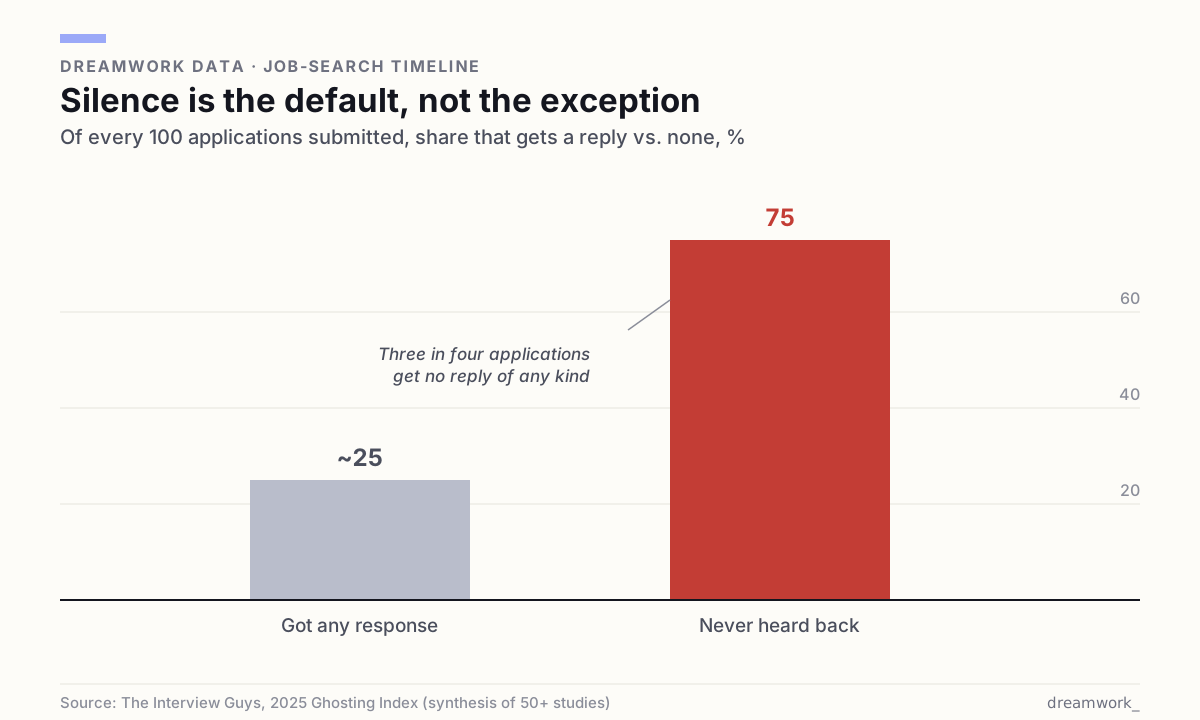
This is why the waiting feels so cruel. You are told to personalize every application, so you treat each one as a real conversation with a real person. The math says most of them are letters dropped into a well. Our full breakdown of how many applications it takes to get a job shows the same funnel from the top: only about 3% of cold applications reach an interview. Read the two numbers together and the silence stops being mysterious. It is arithmetic.
The full timeline, stage by stage
"Hearing back" is not one event. It is a chain of them, each with its own wait. Here is the honest shape of the whole thing, drawn from the response and hiring-timeline data — a rough map, not a promise, because every employer runs its own clock.
| Stage | Typical wait | What it means |
|---|---|---|
| Application → first reply | Median ~6–7 business days; most within 2 weeks | A recruiter screen or interview invite. 75% of applications never reach this step at all. |
| First reply → first interview | About a week after the screen | Scheduling delays, not judgment. Calendars are the bottleneck. |
| Interviews → offer | Often several weeks; offer around week 8 of the process | Multiple rounds, internal debate, approvals. Silence here is common and rarely fatal. |
| Whole process (fill the role) | U.S. average ~35 days; senior roles often 90+ days | The req can outlive your patience by design. |
Those last rows come from hiring-side benchmarks: the average U.S. role took about 35 days to fill in 2025, and for senior positions nearly 40% took more than 90 days (Mitratech / HR.com). Indeed's own stage-by-stage timeline lands an offer around week 8 of the process for roles that move start to finish. Add it up and a "fast" hire is still often a two-month affair. The clock you are watching is not the clock they are running.
Why the silence isn't about you
It is tempting to read an empty inbox as a message. It almost never is. Three structural forces, none of them personal, produce most of the silence you are experiencing.
One: volume. Applying is nearly free now, so postings drown. Around 38% of job seekers now mass-apply using AI tools (2025 Ghosting Index), and recruiter workloads jumped sharply as a result. When a single opening draws hundreds of applications, the reply rate to any one of them collapses — not because yours was bad, but because there were too many to answer.
Two: the process is just slow. Hiring is slow by construction. Roles take weeks to fill even when nothing goes wrong, and applications sit in queues behind approvals, calendars, and competing priorities. Three: ghosting has been normalized. Post-interview ghosting hit 61% in 2025, up nine points since early 2024 (2025 Ghosting Index) — meaning even people who talked to a human, shook the process's hand, still got dropped without a word. If the system will ghost a finalist, an unanswered application was never a referendum on your worth.
When to follow up, and when to move on
Here is the part you can actually act on. The data gives you a clean, unanxious schedule — a way to stop refreshing and start deciding. Follow it and you will never again wonder whether it is "too soon" or "too late."
- Days 1–5: do nothing but keep applying. The median reply hasn't even arrived yet. A follow-up now is noise. Your energy belongs in the next application, not this inbox.
- Days 7–10: send one short, warm follow-up. This is Indeed's recommended window — after one to two weeks of silence. Reaffirm interest, keep it to a few lines, attach nothing new. Send it once.
- Day 14: mentally close the loop. By two weeks, 44% of everyone who will hear back already has. Past this line, a reply becomes unlikely. Move the application to "assume no" and reclaim the emotional bandwidth.
- Days 15–21: one final optional nudge, then release it. If the role matters enough, a second brief note is fair. After that, stop. Chasing silence past three weeks has a near-zero return and a real emotional cost.
- Throughout: never wait on any single application. The strongest move in the entire playbook is to keep the pipeline full so no one "no" — or one silence — can define your week.
That last rule is the whole game. Indeed's own advice reduces to it: diversify and keep applying, because response times are outside your control and a full pipeline is the only real hedge against the wait. If a listing has gone quiet for weeks, it may also simply be one of the many that were never truly being filled — our guide to spotting ghost jobs walks through how to tell before you spend another evening on it.
Wait less by aiming better
You cannot make an employer answer faster. You can change the odds that they answer at all. The response-rate gap between channels — 20–25% through job boards, single digits into a company site — is really a gap between targeted and untargeted effort. Applications to roles you actually fit, sent where a human is accountable for reading them, get answered at multiples of the rate that spray-and-pray does.
That is the quiet thesis of every honest job-search guide: fewer, sharper applications beat a hundred hopeful ones, and they beat them on reply rate, not just on effort. Browsing real, current openings you match — rather than firing into stale listings — is where the wait gets shorter. Dreamwork's live job board lists current openings by role and location, our AI job search ranks them by fit, and our job-search how-to guides cover targeting, follow-up, and vetting a posting before you invest in it. The goal is not to wait more patiently. It is to send applications that were more likely to be answered in the first place.
So refresh your inbox one last time, then close it. The number you were looking for is this: one to two weeks to a reply, or a silence that was never about you. Read the silence for what it is — an overloaded system, not a judgment — and put your next hour where it pays: into the application after this one.
Frequently asked questions
How long does it take to hear back from a job after applying?
When an employer replies, the median wait is about 6 to 7 business days, and 44% of people who hear back do so within two weeks (Indeed). Only 4% hear back within a single day. The catch is that roughly 75% of applications never get a reply at all, so a fast answer only applies to the minority that get one.
How long should I wait before following up on a job application?
About one to two weeks. Indeed recommends sending a short, warm follow-up after 7 to 10 days of silence, then an optional second note a week later. Before that, a follow-up is premature — the median first reply hasn't even landed yet. Keep it brief and send it only once or twice.
When should I give up on hearing back and move on?
Around the two-week mark. By 14 days, 44% of everyone who will ever hear back already has, and the reply rate barely climbs after that. Treat two to three weeks of silence as a soft no, stop refreshing, and redirect your energy to new applications. The study behind these numbers treats 45 days with no reply as effectively closed.
Why haven't I heard back after applying to so many jobs?
Mostly because roughly 75% of applications get no response of any kind (2025 Ghosting Index), driven by application volume, slow hiring timelines, and normalized ghosting — not by anything you did wrong. Even 61% of interviewed candidates get ghosted. Silence is the funnel's default outcome, not a verdict on your resume.
How long after applying will I get an interview?
If you get one, the first interview or screen usually follows the first reply by about a week, and the median first reply arrives 6 to 7 business days after you apply. So expect roughly one to three weeks from application to a first interview — for the applications that advance at all. Most never reach this stage.
How long does the whole hiring process take?
Longer than it feels like it should. The average U.S. role took about 35 days to fill in 2025, senior roles often exceed 90 days (Mitratech / HR.com), and an offer commonly arrives around week 8 of a full process (Indeed). A slow, quiet stretch mid-process is normal and rarely means rejection.
Sources
- Indeed Career Advice — How Long Should You Wait To Hear Back About a Job (37% within a week, 44% within two weeks)
- Careery — How Long to Hear Back After Applying (2026 Data): median 6.7 days, middle 50% 4.5–8.1 days
- TechRSeries — New Research Reveals How Long It Actually Takes to Hear Back (1,000+ candidates, 45-day window)
- The Interview Guys — The 2025 Ghosting Index (75% no response, channel response rates, 61% post-interview ghosting)
- Indeed Career Advice — The Typical Interview Timeline (offer around week 8, start 2–4 weeks after accepting)
- Mitratech — What 2025 Time-to-Fill Benchmarks Reveal (U.S. average ~35 days; senior roles 90+ days), citing HR.com