How Many Applications Does It Take to Get a Job? (2026)
The folk answer is 100–200. The real number is conditional — it depends on how you apply, not how much.
Most people get hired somewhere between 50 and 200 applications, but that range hides a 10x spread. In 2026 only about 3% of applications lead to an interview (CareerPlug), and the average job seeker sends 32 applications for 4 interviews before an offer (Career.IO). Targeting, tailoring, and referrals move that number far more than volume does.
The short answer, and why it's a trap
The number of applications it takes to get a job is not a fact about you. It is a measurement of how much friction the labor market has decided the worker should absorb. So here is the honest answer, plainly, before the caveats: most people land a job somewhere between 50 and 200 applications — and that range is nearly useless without context, because the real spread is close to 10x depending on how you apply.
The most-cited numbers cluster tightly once you read the actual studies. Career.IO's 2025 data found the average job seeker applies to 32 jobs and gets 4 interviews before being hired. Application-tracking data from Huntr (461,000 applications, Q2 2025) found 14.3% of people needed more than 100 applications before a single offer. Resume Genius and others put the folk number at 100–200+. All of these are true at once, because they measure different people running different strategies.
The real math is conditional
There is no universal law here, only a conversion rate — and that rate swings by roughly 10x based on channel, targeting, and timing. In 2024, a CareerPlug analysis of more than 10 million applications across more than 60,000 employers found the applicant-to-interview ratio was just 3%. Employers received an average of 180 applicants per hire. Those two numbers set the baseline for cold applications to public postings. But the baseline is the worst-case path, not the only one.
Change the channel and the math changes underneath you. Here is what the data says actually moves the needle:
| How you apply | What the data shows |
|---|---|
| Cold application to a public posting | About 3% reach an interview (CareerPlug, 2024) |
| Tailored resume and cover letter | Roughly double the interview rate of a generic one (The Interview Guys, 2025) |
| An employee referral | Worth about 40 cold applications (Gem, 2025) |
| Being sourced by a recruiter | About 5x more likely to be hired than an online applicant (Gem, 2025) |
Read that table again. The difference between a cold click and a referral is not 20% or 50%. It is an order of magnitude. Which means the question "how many applications?" is the wrong question. The right question is "which applications?"
Why the number keeps climbing
The number you need has been getting worse for a decade, and the trend is not subtle. The applicant-to-interview rate fell from 15.25% in 2016 to 8.4% in 2023 to about 3% in 2024 (CareerPlug). Same resumes, same people, a fraction of the responses. Something structural is bending the odds.
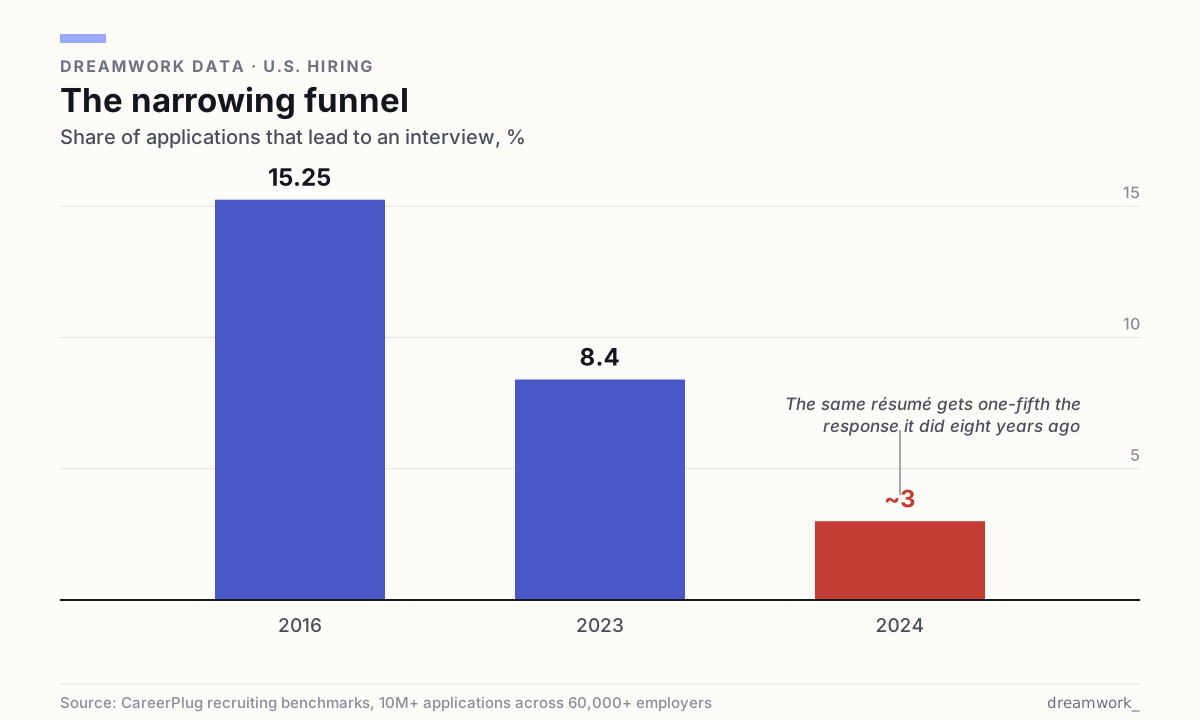
It is an arms race, and it runs on a feedback loop. Everyone applies to more jobs to hedge against low response rates. Employers drown — 180 applicants per opening — so they filter harder with applicant tracking systems and tighter screens. Response rates fall further. So everyone applies to even more. Applying more is a perfectly rational move for you as an individual, and it quietly degrades the system for everyone, including you. You are not the problem in this loop. You are trapped inside it.
The accelerant in 2026 is displacement plus automation. Dreamwork's live job index tracks 343,819 active listings as of June 2026, and our AI Labor Index shows AI is now the #1 stated reason for U.S. layoffs, cited in 40% of them. More displaced workers competing for openings, plus tools that make sending 100 applications trivial, means more volume stacked against every posting. The funnel narrows precisely as the pressure to feed it grows.
The diminishing-returns cliff
Here is the finding that should end the "just apply to more" advice for good. Federal labor economists Michael Dalton and Jeffrey Groen, in the BLS Beyond the Numbers study using Current Population Survey data, measured offer rates by how many applications people actually sent. The chances do not keep rising with volume. They peak, then fall off a cliff.
| Applications sent | Chance of getting an offer |
|---|---|
| 1–10 | 27.2% |
| 11–20 | 29.5% |
| 21–80 | 30.9% |
| 81+ | 20.4% |
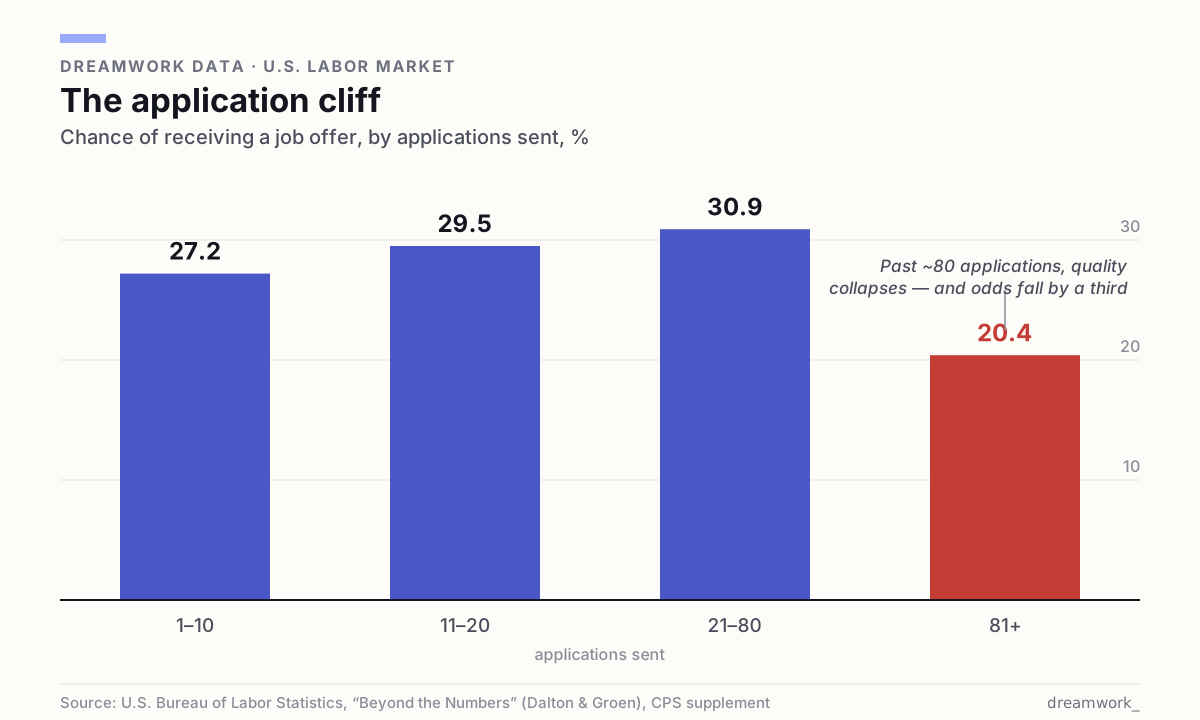
Look at the bottom row. People who sent 81 or more applications were less likely to get an offer than people who sent 21 to 80. Volume past a point is not neutral — it actively hurts. The mechanism is obvious once you name it: quality collapses under quantity. By Q3 2025, the busiest 10% of job seekers averaged 83 applications per week — nearly 12 a day (The Interview Guys). No human can research a company, tailor a resume, and write something meaningful twelve times before lunch. Past the cliff, you are not applying. You are gambling with worse odds and calling it effort.
So how many job applications per day?
This is the question underneath the question, so let's answer it directly. Because tailoring roughly doubles your response rate and a single referral outweighs 40 cold clicks, the math points one way: a small number, done well, beats a large number done fast. The right daily pace is not "as many as possible."
- 2–5 targeted applications per day, each one actually tailored to the role.
- Roughly 10–15 per week, or 50–100 over six to eight weeks — the range where offer rates peak.
- Reserve real time for referrals and warm intros. One is worth about 40 cold applications, so an hour spent there beats an hour spent spraying.
- If you cross 80 applications with nothing landing, stop and change the strategy — not the volume. The problem is upstream of effort.
Above roughly 25 applications a day, two things break at once: the quality of each application, and your ability to actually manage the interviews if they come. Pacing is not laziness. It is the only version of this that the data says works — and the only version that lets you still be standing in month three.
Why you're not hearing back (it isn't you)
Silence feels like a verdict. It is usually just a slow process. Hiring is slow in a way that has nothing to do with your worth. The average time to fill a role reached about 44 days in 2025 (SHRM Recruiting Benchmarking Report). Median time to a first offer hit 68.5 days in Q2 2025, and only 41% of people found a job within a month — down from 49% the prior quarter (Huntr).
The federal data tells the same story. The median unemployed worker in 2025–26 spent roughly 10 weeks looking, and as of June 2026 the long-term unemployed — jobless 27 weeks or more — numbered 1.9 million, about 27.3% of everyone out of work (BLS Employment Situation). When a third of job seekers are stuck past six months, the silence you are hearing is a system running slow, not a message about you.
Apply better: what actually moves the number
If the answer is not "apply more," it is "apply better and refuse to burn out." Concretely, that means three things, in order of impact. Chase referrals — they are the single highest-leverage move you have, worth roughly 40 cold applications each. Tailor every application — the same resume, rewritten to match the posting, roughly doubles your interview rate. And target narrowly — apply to roles you actually fit, because the New York Fed's SCE Labor Market Survey found only 19.4% of job seekers received any offer in a given four-month window, and fit is what separates that fifth from the rest.
The hard part is doing all of that at a humane pace, on repeat, for weeks, without your quality decaying into the 81-plus death zone. That is genuinely difficult to sustain by hand — this is literally why we built Dreamwork: to match you to the roles that fit and do the tailoring, so you send fewer, sharper applications instead of feeding the arms race. If you'd rather work the manual playbook, our how-to guides walk through referrals, targeting, and tailoring step by step. Either path beats volume for its own sake.
The number is a verdict on the system, not on you
Strip away the folklore and here is what the evidence actually says. There is no magic count. The honest range is 50 to 200 applications, with a 10x spread you control through channel and care. Volume helps until about 80, then it hurts. Referrals and tailoring beat raw quantity by an order of magnitude. And the slowness that makes you feel invisible is a 44-day median, not a judgment.
The "100–200 applications" number that everyone repeats is not a law of the universe. It is a symptom — of a hiring machine that has quietly offloaded its inefficiency onto the person who can least afford it. You cannot fix the machine by feeding it harder. You can refuse to let it set the terms: apply better, protect your pace, and read the number for what it is. Not a measure of you. A measure of how broken the funnel has become.
Frequently asked questions
How many jobs should I apply to at once?
Aim for a running pipeline of roughly 50–100 well-targeted applications over six to eight weeks, not a one-time blast. BLS data shows offer rates peak in the 21–80 range and actually fall for people who send 81 or more, so more is not better past that point.
How many job applications should I send per day?
About 2–5 per day, each tailored to the role — roughly 10–15 a week. Past 25 a day, quality drops and you can't manage the interviews if they land. Spend the time you save chasing referrals, which are worth about 40 cold applications each.
Why am I not hearing back on my applications?
Mostly because hiring is slow, not because you failed. The average role takes about 44 days to fill (SHRM, 2025) and the median time to a first offer is 68.5 days (Huntr). Only about 3% of cold applications reach an interview, so long silences are the norm — a slow funnel, not a no.
Does applying to more jobs improve my chances?
Only up to a point. BLS research (Dalton and Groen) found offer rates rise through 21–80 applications, then drop for people who send 81 or more — from about 31% down to about 20%. Past the cliff, quality collapses and your odds get worse, not better.
How long does it take to hear back after applying?
Often weeks. Median time to a first offer was 68.5 days in Q2 2025, and only 41% of job seekers found a role within a month. The median unemployed worker in 2025–26 spent about 10 weeks searching, per BLS data.
How many applications does it take to get a job in 2026?
Realistically 50–200, but the range depends far more on how you apply than how much. The average job seeker sends about 32 applications for 4 interviews before an offer (Career.IO), and only about 3% of cold applications lead to an interview (CareerPlug). Referrals and tailoring shrink the number dramatically.
Sources
- CareerPlug — 2025 Recruiting Metrics & Benchmarks Report (10M+ applications)
- BLS Beyond the Numbers — Dalton & Groen, "How do jobseekers search for jobs?"
- BLS — The Employment Situation, June 2026 (duration of unemployment, Table A-12)
- SHRM — 2025 Recruiting Benchmarking Report (time to fill)
- The Interview Guys — State of Job Search 2025 Research Report
- The Interview Guys — How Many Applications to Get One Interview (27 studies analyzed)
- The Interview Guys — The Application Paradox (offer rate by volume, weekly pace)
- Federal Reserve Bank of New York — SCE Labor Market Survey