What Happens to Your Resume After You Apply in 2026
One application, walked from the confirmation screen to the moment it stops moving, with a verified number on every stage that has one.
Your resume joins a queue. For the average corporate opening that queue holds about 250 applications. A recruiter works it as a ranked list, spends roughly seven seconds on each resume that gets opened, and invites about 3 in 100 applicants to interview. Around a quarter of those interviews end in a hire. Most of the rest are closed without anyone telling you.
The moment you hit submit
The confirmation screen is the last honest thing most applications ever say to you. After that the process goes quiet, and people read the quiet as a verdict on them. It is mostly arithmetic.
So here is the walk. One application, from the click to the moment it stops moving, in the order it actually happens, with a verified number attached to every stage that has one and a plain admission where none exists.
The first thing that happens is that your resume stops being a document and becomes a row. Jobscan's annual audit found a detectable applicant tracking system on 489 of the 500 Fortune 500 career pages, or 97.8 percent, and puts the typical corporate posting at around 250 applicants (Jobscan, 2025).
That average hides an enormous spread. The same audit puts automotive roles near 212 applications each and hospitality and entertainment roles near 25. Which queue you joined matters more than almost anything you did to the document itself.
Nothing has been decided at this point. Nothing has been read. You are one row among a couple of hundred, and the clock has started.
The queue, and who is looking at it
The person who eventually opens your application is a recruiter working a list, and the list arrives already sorted. It is not a stack of paper on a desk and it never was.
What that sorting does to you is the most rumored part of the whole journey, and the most poorly evidenced. The claim you have heard is that 75 percent of resumes are rejected by software before a human ever sees them. It has no primary source. The Interview Guys traced the figure to a 2012 sales pitch by a resume-optimization company that shut down in 2013, with no methodology ever published behind it (The Interview Guys, 2025).
The better-sourced version is duller. More than 90 percent of employers filter or rank candidates by skills, credentials and experience before anyone reads a word, on a Harvard Business School survey cited in the same audit (Jobscan, 2025). Filtering is real and it is nearly universal. Blanket automatic rejection is a different claim, and the evidence for it is thin.
Here is the honest gap, and it is a large one. There is no reliable public figure for what share of submitted applications are ever opened by a person at all. Employers do not publish it, and no survey has measured it credibly. Anyone who quotes you a percentage there is guessing. If you want the full picture of what these systems do and do not do, we take it apart in our explainer on applicant tracking systems.
The seven-second glance
Assume you make it into the set a recruiter actually looks at. This is the stage everybody imagines wrongly. It is not a reading. It is a glance.
Ladders ran an eye-tracking study on recruiters in 2012 and found an average of six seconds on the initial screen of a resume. It reran the study in 2018 and the number came out at 7.4 seconds (Ladders, 2018). The company attributed part of the increase to the fact that the original had been run during the recession, when the pile per opening was even worse than usual.
The famous "six-second resume" is therefore the older figure, and the follow-up revised it upward rather than down. Both numbers describe the same behavior: a scan for job titles, dates, company names and layout, not a considered read of your accomplishments.
That is not laziness. It is what a person does with two hundred documents and a calendar full of other work. It does mean the top third of the first page carries almost the entire load, which is why the formatting fixes that matter are the boring structural ones and not the clever ones.
Where three in a hundred become interviews
The next thing that happens to your application is that it either produces an invitation or it does not, and this is the narrowest point of the entire journey.
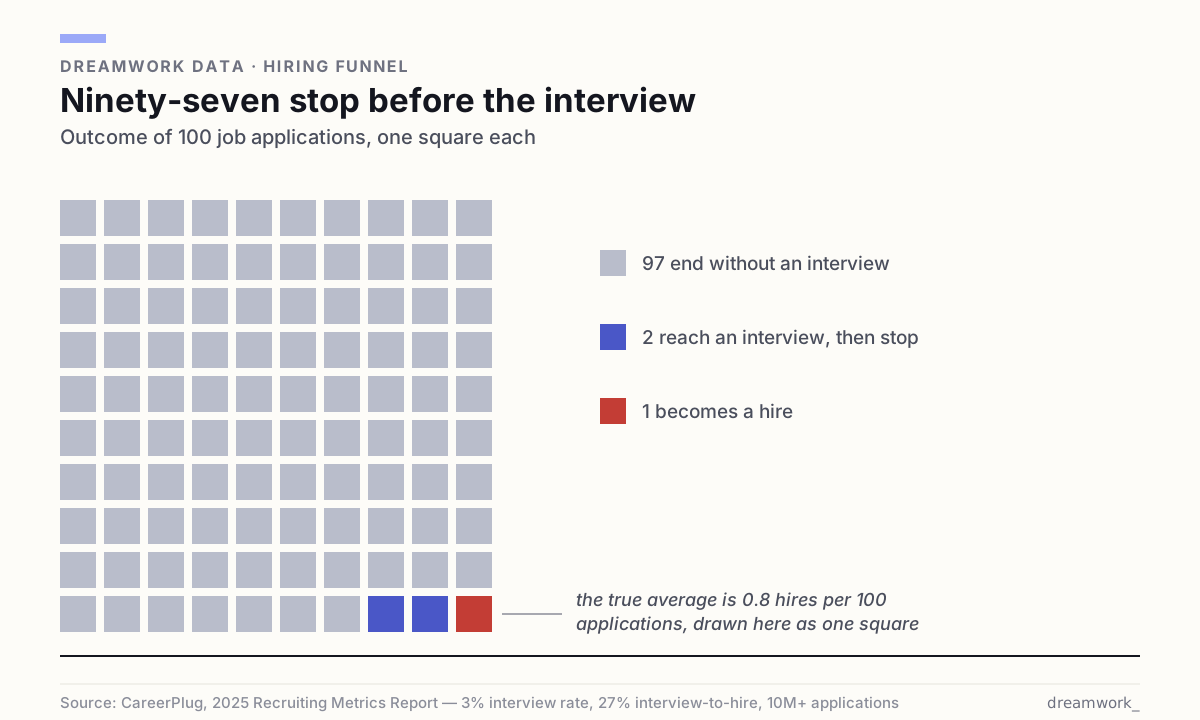
CareerPlug analyzed more than 10 million applications across over 60,000 small-business employers and found that employers invited an average of 3 percent of applicants to interview (CareerPlug, 2025). Ninety-seven of every hundred applications end here, at a stage that produces no email, no feedback and no event you can see.
The volume side of the same report moved sharply. Employers received an average of 180 applicants per hire in the 2024 data, against 93 the year before (CareerPlug, 2025). The pile roughly doubled in twelve months while the interview rate did not move to meet it.
Industry changes the odds more than any individual choice does. The same report puts automotive roles near 234 applicants per hire and education and childcare roles near 57. A four-fold difference in competition, with the same resume.
The interview, and the other three quarters
Say the invitation comes. Something real has happened: a person made a decision about you specifically, and for the first time your application has a name attached to it inside the company.
Then the funnel narrows again. Employers converted 27 percent of interviews into hires (CareerPlug, 2025). About three in four people who reach an interview still do not get the job, and unlike the earlier stages this one usually does come with a human on the other end of it.
Those two rates do not perfectly reconcile with the headline average, and it is worth saying so rather than smoothing it over. Three percent invited multiplied by 27 percent hired implies roughly one hire per 125 applications, while the same report's headline figure is one hire per 180 applicants. The report does not explain the gap. Both numbers point the same direction, which is the point.
If you want the volume question answered properly, with offer rates by how many applications people sent, that lives in our piece on how many applications it takes. This article is about what the application is doing while you wait.
The clock nobody shows you
Every stage above has a duration, and none of them are displayed to you. This is where most of the suffering in a job search actually lives.
SHRM surveyed 2,371 of its members in early 2025 and put the median span from job posting to accepted offer at roughly a month and a half, for executive and nonexecutive roles alike. Its release describes the process as highly segmented, "with screening and interviewing alone averaging 8–9 days each" (SHRM, 2025).
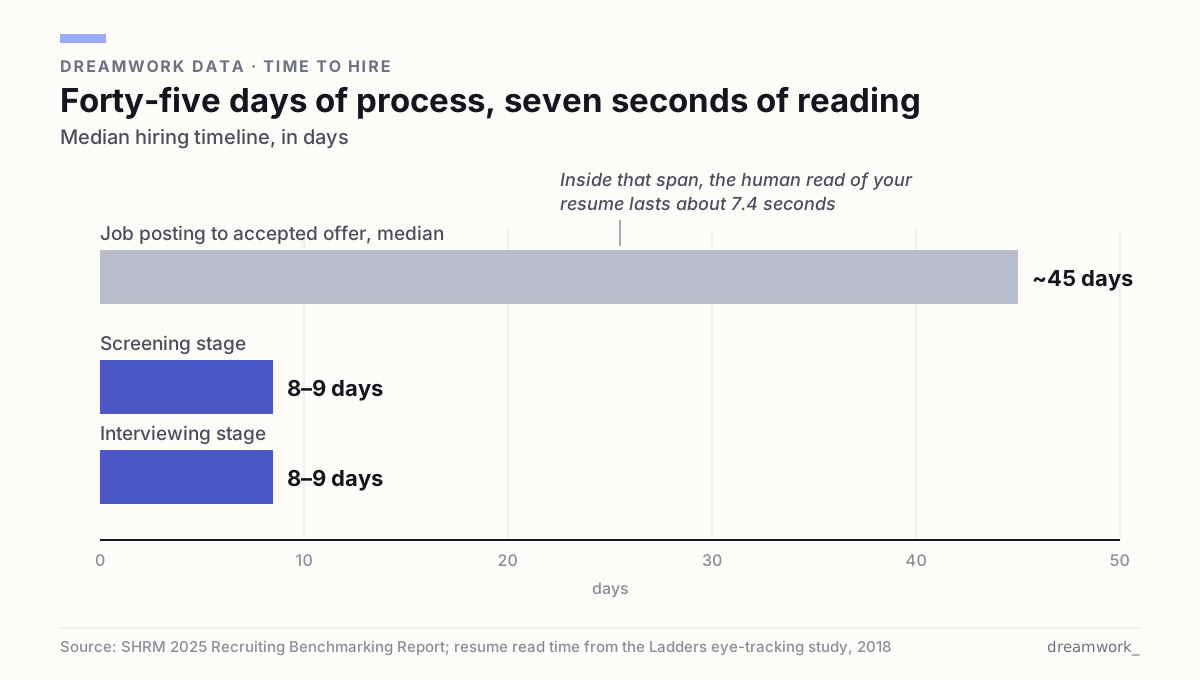
Read those two facts against each other. A process that runs about 45 days end to end contains, for you, roughly seven seconds of anyone actually reading what you wrote. The waiting is not suspense. It is other people's calendars.
That also means silence in week one carries almost no information. Our companion piece on how long it takes to hear back has the reply-time distributions and the point at which waiting stops being rational.
Where it stops moving
Most applications do not end with a decision you are told about. They end with a status change you never see.
Enhancv surveyed 1,066 United States job seekers in April 2026 and found that 50.5 percent had received at least one rejection in the past year with no explanation and no feedback from a human recruiter (Enhancv, 2026). Among those, 63.8 percent believed an algorithm rather than a hiring manager had made the final call.
The disclosure numbers from the same survey are worse than the rejection numbers. Only 9.7 percent of respondents were clearly told an automated system had evaluated their application, and 68.5 percent said no involvement was ever disclosed to them (Enhancv, 2026). The decision existed. The notification was optional, and so was the explanation.
There is a second honest gap here. No credible public figure exists for the share of all submitted applications that ever receive a rejection notice of any kind. Surveys measure how many job seekers have experienced silence, which is a different question and a much easier one to answer.
The behavioral consequence is already visible. In the same survey, 31.4 percent of job seekers said they had abandoned an application or declined an interview specifically to avoid automated screening, and 79.1 percent of those abandoned applications were for roles paying under $100,000 (Enhancv, 2026).
What the walk changes about how you apply
Nothing above is a reason to stop applying. It is a reason to spend your effort where the funnel is actually narrow rather than where the advice industry says it is.
- Pick the queue before you polish the document. A four-fold difference in applicants per hire between industries outweighs any formatting change you can make.
- Write for a 7.4-second glance. Titles, dates, employers and one line of evidence, all above the fold, because that is the whole budget.
- Stop reading silence as feedback. At a 3 percent interview rate, no reply is the median outcome and carries no information about you.
- Give it about six weeks before you write it off. The median process runs roughly 45 days end to end, and two of its stages take 8 to 9 days apiece.
- Track what you sent, because nobody else will. Roughly half of job seekers get rejections with no explanation, so your own record is the only reliable history of the search.
The one thing the walk does not support is the story people tell themselves at 2am, which is that a machine threw the resume away before anyone saw it. The best-evidenced version is less dramatic and harder to live with: a person looked, briefly, alongside two hundred others, and then the file was closed without anyone writing to you.
Knowing which stage swallowed the application does not get you the job. It does tell you where the effort belongs, and it stops you rewriting a resume that was never the problem. If you want to start from the queue rather than the document, our live job index and how-to guides are the place to do it.
Frequently asked questions
What happens to my resume after I apply?
It becomes one row in an applicant tracking system, alongside roughly 250 others for the average corporate opening (Jobscan, 2025). Employers filter and rank that list before anyone reads it, a recruiter spends about 7.4 seconds on each resume that gets opened (Ladders, 2018), and around 3 percent of applicants are invited to interview (CareerPlug, 2025).
Does a real person actually read my resume?
Someone looks at it, but briefly, and only if it survives the filtering first. Eye-tracking research puts the initial screen at an average of 7.4 seconds, up from 6 seconds in a 2012 version of the same study (Ladders, 2018). There is no reliable public figure for what share of submitted applications are opened by a person at all.
Is it true that 75 percent of resumes are rejected by software?
No, that figure has no traceable primary source. It was traced back to a 2012 sales pitch by a resume-optimization company that shut down in 2013, with no methodology ever published (The Interview Guys, 2025). What is documented is that more than 90 percent of employers filter or rank candidates by skills, credentials and experience before a person reads anything (Jobscan, 2025).
How long should I wait before assuming I was rejected?
Give it about six weeks. SHRM puts the median span from job posting to accepted offer at roughly a month and a half, with screening and interviewing each averaging 8 to 9 days inside that (SHRM, 2025). Silence in the first two weeks is the normal shape of the process, not a signal about your application.
Why do I never get a rejection email?
Because sending one is optional and increasingly skipped. Half of United States job seekers, 50.5 percent, received at least one rejection in the past year with no explanation and no human feedback (Enhancv, 2026). The decision was made and recorded on the employer's side; only the message to you was left out.
How many applications does it take to get one interview?
About 33, on the largest published dataset. Employers invited an average of 3 percent of applicants to interview across more than 10 million applications, and converted 27 percent of those interviews into hires (CareerPlug, 2025). The same report puts the overall average at 180 applicants per hire.
Sources
- Jobscan: Applicant Tracking System Usage Report (97.8% of Fortune 500 career pages, ~250 applicants per corporate opening, >90% of employers filter or rank candidates, industry spread)
- CareerPlug: 2025 Recruiting Metrics Report (10M+ applications, 60,000+ employers: 3% application-to-interview, 27% interview-to-hire, 180 applicants per hire, industry breakdowns)
- CareerPlug: Hiring Metrics: A Data-Backed Guide for Employers (180 applicants per hire in 2024 against 93 the prior year)
- Ladders: Updated recruiter eye-tracking study, November 2018 (7.4 seconds on the initial resume screen, revised up from 6 seconds in 2012)
- HR Dive: Eye-tracking study shows recruiters look at resumes for 7 seconds (Ladders, 2018)
- The Interview Guys: The ATS Resume Rejection Myth (origin of the 75% claim in a 2012 sales pitch; company closed in 2013; no published methodology)
- SHRM: 2025 Benchmarking Reports press release (2,371 respondents; screening and interviewing averaging 8–9 days each; cost per hire)
- SHRM Executive Network: The State of Recruiting 2025 (median time to fill of roughly 1.5 months for executive and nonexecutive roles)
- Enhancv: AI Hiring in 2026 survey of 1,066 U.S. job seekers, April 2026 (50.5% silent rejections, 68.5% no disclosure, 31.4% abandoned applications)
- National Law Review: press release on the Enhancv study (sample size, field dates, 63.8% believed an algorithm decided)