How Does Indeed Work? An Applicant's 2026 Guide
What happens after you hit apply, why sponsored listings shape what you see, and where the funnel actually loses you.
Indeed is two products in one. It is a search engine over job listings, most of which start life on an employer's own careers page, and it is an application system employers can switch on. That second half decides your experience: whether you apply in seconds on Indeed or get handed to a company's own form, and what the employer sees when you do.
The two things Indeed is at once
Most people use Indeed for years without ever learning what it is. That is not a failure of curiosity. Search boxes are built to hide their machinery. But the machinery decides what you see, and what happens to the application you spent an evening on.
Indeed is two products stacked on each other. The first is a search engine over job listings. Most of those listings did not originate on Indeed at all: they exist on an employer's own careers page and appear in Indeed's index. Indeed calls those indexed jobs, as distinct from hosted jobs an employer posts directly on the site.
The second product is an application system. An employer can switch on Indeed's own apply flow, which keeps you inside Indeed and delivers your saved profile to them. Or they can leave it off, in which case the listing hands you to their site and Indeed's involvement ends at the click. Almost everything confusing about Indeed comes from these two products wearing the same interface.
The scale is not in dispute. Indeed reports 665 million job seeker profiles, 3.5 million employers, operations in more than 60 countries, and 31 hires a minute as of March 2026 (Indeed). It calls itself the world's number one job site, citing Comscore traffic data.
Scale is not the same as a hiring boom, and Indeed's own researchers say so. Its Job Postings Index sat at 101.0 in June 2026, roughly where postings stood before the pandemic and down 3.7 percent from a year earlier (Indeed Hiring Lab). The market the board reflects is flat.
The two buttons, and why they are not the same
Every listing hands you one of two buttons, and the difference is larger than the interface admits.
"Apply now" on a listing carrying the Easily apply badge keeps you on Indeed. You submit your Indeed profile, which holds your resume and credentials, and your saved information fills the required fields plus any employer questions (Indeed). You get an on-screen confirmation, a confirmation email, and a row in the Applied tab of My jobs.
"Apply on company site" sends you out the door. Your application is submitted through the employer's own system, Indeed does not send a confirmation email, and Indeed cannot tell you what happened next (Indeed). If you want to follow up, you contact the company yourself.
| What you get | Easily apply on Indeed | Apply on company site |
|---|---|---|
| Where the form lives | On Indeed, pre-filled from your profile | On the employer's site, usually from scratch |
| Confirmation email | Yes, from Indeed | No, Indeed sends nothing |
| Status tracking | Applied tab of My jobs | Only whatever the employer's system shows you |
| Typical time to submit | Median 44 seconds | Often 10–30 minutes, sometimes an account signup |
| Who to chase | Employer, via Indeed messages | Employer directly |
That second row explains most of the confusion. When people say their applications "disappeared into Indeed," they usually used the second button, where Indeed never held the application in the first place.
Speed is the entire design of the first button. Indeed tells employers that a job seeker completes an Indeed Apply submission in a median of 44 seconds, and that 79 percent of applications on the site are finished on a phone (Indeed). That is a serious piece of engineering.
What the employer sees on their side
Your application does not land in somebody's inbox. It lands in a dashboard, as a row, with a status.
Applicants enter an employer's Indeed dashboard marked New, then move through Reviewing, Contacting, Interviewing, and finally Hired or Rejected (Indeed). Employers filter that list by location, by qualifications, and by how you answered the screener questions. They can forward resumes, send templated messages in bulk, and keep private notes comparing you with other candidates.
One line in Indeed's employer documentation explains a great deal of silence. Applicants whose answers fail the required screener criteria are marked Rejected automatically, and those candidates "will not be notified of their application status unless you send them a response" (Indeed). The screening happened. Telling you about it is optional.
When Indeed Apply is switched on for an indexed job, the application flows into the employer's applicant tracking system with the fields already populated, and outcome data flows back to Indeed. Indeed publishes what that arrangement buys them: about 40 percent more apply starts on indexed jobs, five times more completed applications, and jobs 2.4 times more likely to lead to a hire (Indeed).
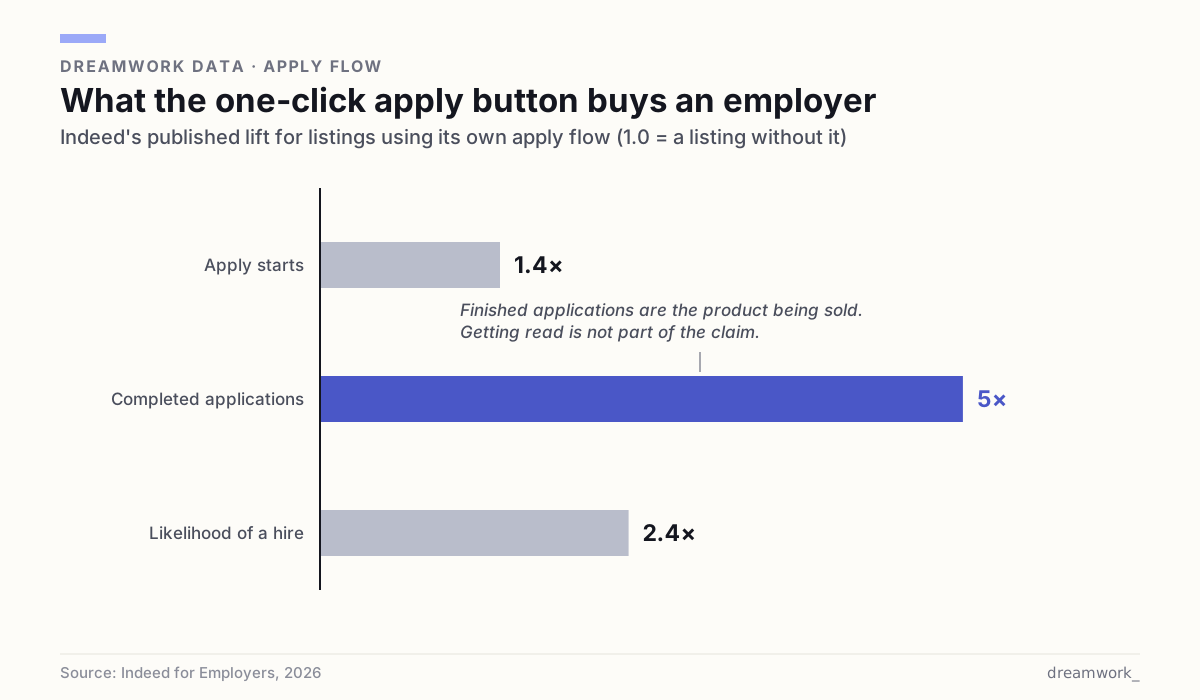
Read that from your side of the table. Nothing in the pitch is a promise that any individual application gets read. The promise is throughput.
Sponsored, organic, and why your results look the way they do
Indeed is free for you because employers pay, and increasingly what they pay for is placement.
A free post is capped and perishable. Employers get three per calendar month, each visible for up to 30 days, and in Indeed's own description a free post "falls back in job seeker search results as new jobs are posted" (Indeed). Sponsored jobs appear more often and for longer and never need reposting. Premium Sponsored adds targeting by skills and credentials, plus direct invitations to matched candidates.
Then the floor moved. Since March 31, 2026, jobs delivered to Indeed through certain free single-source feeds no longer receive organic visibility unless they are sponsored or arrive through a supported applicant tracking system integration. Indeed told HR Dive it prefers those integrations for "improved reliability, data quality, and consistency" (HR Dive, 2026).
As free visibility narrows, the listings that reach the top of your search tilt further toward employers with a budget. It does not mean the roles from employers who do not spend stopped existing. It means you now have to look somewhere else to see them. Our companion piece on whether Indeed is getting worse takes apart the ranking side of this in detail.
A useful filter falls out of the same economics. Employer-provided salary is a visibility input, and Indeed tells employers that jobs showing a salary get 5.1 times more impressions per job than those without (Indeed). A search restricted to postings with a stated range is not just filtering for pay. It is filtering for employers who were willing to say the number out loud.
The resume database is the other product
The apply flow is only half of what Indeed sells. The other half is you, findable.
Indeed's sourcing product lets an employer search profiles and message people who have not applied to anything. The Professional plan runs $520 a month for 100 contacts, with additional contacts at $5.20 each (Indeed). Employers narrow the pool by willingness to relocate, recent activity, and job type, and Indeed says employers who invited matched candidates to apply hired 40 percent faster.
Which means your profile carries a visibility setting. Public makes your resume searchable by employers paying for that access. Private limits it to the employers you actually applied to, and your resume still works normally for applying (Indeed).
There is no correct answer here, only a trade. Public buys inbound messages, some of them real opportunities and some of them a recruiter working a keyword. Private buys quiet. If you are employed and looking, private is usually the honest choice. If you are openly searching and can tolerate noise, public is a free inbound channel most people leave off without deciding to.
Where the funnel actually loses people
Now the part no product page has an incentive to tell you.
Across the market, roughly 75 percent of job applications receive no response at all (2025 Ghosting Index). Not a rejection. Nothing. The same synthesis breaks reply rates down by where the application was sent, and the order surprises anyone told for years to go straight to the company site.
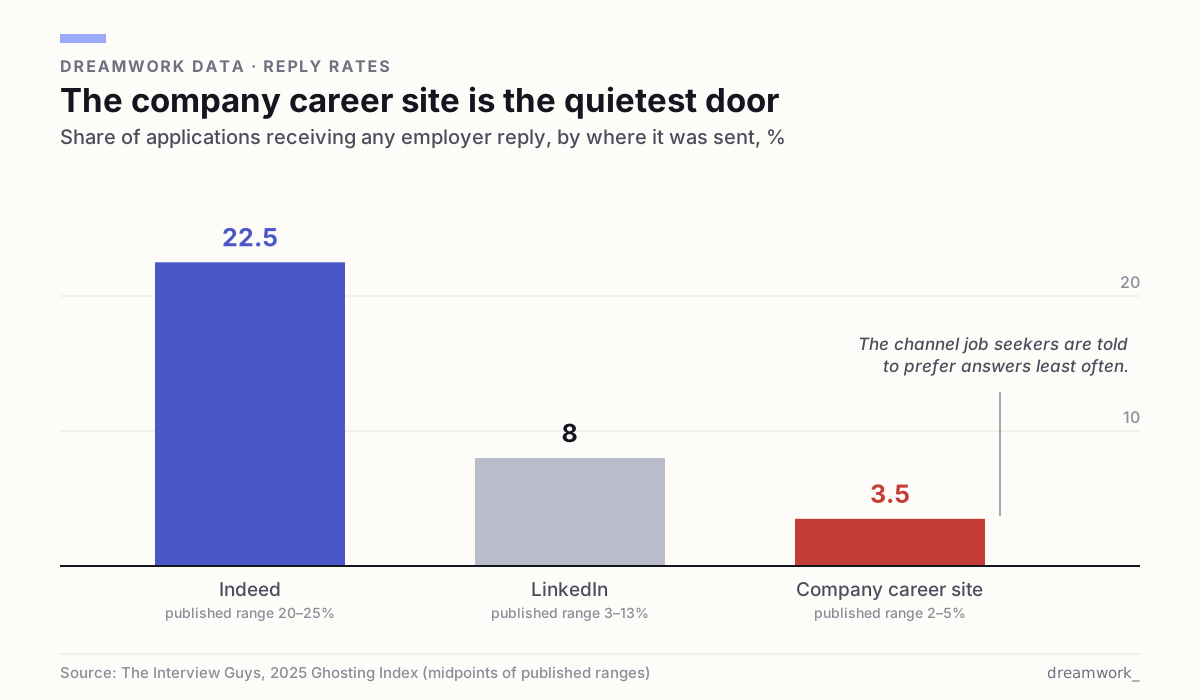
Applications sent through Indeed drew replies at 20 to 25 percent. LinkedIn ran 3 to 13 percent. Applications submitted straight into a company's own career site came in at 2 to 5 percent (2025 Ghosting Index). Industry moved the number as much as platform did: technology sat near 5 percent while healthcare reached about 20.
Handle that comparison carefully. It is a synthesis, not a controlled experiment, and the channels differ in who uses them and for which roles, so part of the gap is mix rather than platform. What it does defeat is the advice that the company site is always the higher-response path.
The other loss is time. The same report puts the average time cost of a single ghosted application process at 47 hours (2025 Ghosting Index). That is the real leak: not the rejection, which at least closes something, but the weeks spent waiting on applications that were never going to be answered. Our data on how long it takes to hear back covers when to stop waiting.
So which button should you press
Here is the practical version of everything above, in the order it pays off.
- Use the Indeed button when it exists. It is faster, it is tracked, and on the only public reply-rate figures available it does not lose to the company site.
- Apply on the company site when that is the only option. Do it carefully, because none of that application is visible to Indeed and nobody will chase it on your behalf.
- Do not do both for the same role. Duplicate applications usually land in the same system twice and read as noise rather than enthusiasm.
- Set your profile visibility deliberately. Decide once whether you want inbound messages, then stop wondering why recruiters do or do not write.
- Answer every screener question completely. A blank or disqualifying answer can close your application before a person ever opens it, and nobody has to tell you.
Individual results vary more than any of this suggests. Users on Blind describe exactly the split the data implies: one poster reported several replies through Indeed for manufacturing roles after 300 LinkedIn applications produced none, while another wrote "I have never gotten a role or response while using indeed" (Blind). Seniority and industry move the outcome more than the platform does.
What Indeed is good at, and what it isn't
Indeed is unmatched at breadth. If a job exists in the United States and the employer wanted anyone at all to know, there is a strong chance it shows up there, and for hourly, local, and non-office work nothing else is close.
What it is not is a system working on your behalf. It is a marketplace whose paying customers are employers, tuned to produce completed applications in under a minute each. That is a coherent business. It also means the expensive part of your search, deciding which roles deserve a real application and then making each one specific, is the part nobody on the other side of the transaction is optimizing.
So use it for what it is genuinely good at and stop asking it to be the whole map. Read a posting before you spend an evening on it, because some of them are not real openings. Learn what happens to your resume once it reaches the employer, in our explainer on applicant tracking systems. And when you want roles ordered by fit rather than by who paid, that is what AI job search is for; our live job index and how-to guides take no money to move a listing up, and Dreamwork vs Indeed sets Indeed and Dreamwork side by side.
Forty-four seconds to send an application. Three in four applications answered with silence. Those two numbers are the same fact viewed from opposite ends of the same pipe, and knowing which end you are standing at is most of what there is to understand about how Indeed works.
Frequently asked questions
How does Indeed work for job seekers?
Indeed combines a search engine over job listings with an optional application system. Most listings exist on an employer's own careers page and appear in Indeed's index; some employers also switch on Indeed's apply flow, which lets you submit your saved Indeed profile without leaving the site. Employers pay Indeed for placement and for access to job seeker profiles, which is why it is free to you.
Is it better to apply on Indeed or the company website?
Use the Indeed button when the listing offers it. The only public breakdown of reply rates puts applications sent through Indeed at 20 to 25 percent and applications submitted into a company's own career site at 2 to 5 percent (2025 Ghosting Index). Applying on Indeed is also tracked in My jobs and confirmed by email, which an outbound application is not.
What does Easily apply mean on Indeed?
Easily apply means the employer turned on Indeed's own application flow, so you can apply without being sent to an external site. Your Indeed profile fills the required fields and any employer questions, and the median submission takes about 44 seconds (Indeed). Listings without the badge send you to the employer's own form instead.
Can employers see my resume on Indeed if I never applied to them?
Yes, if your profile visibility is set to public. Employers pay for a sourcing product that searches profiles and messages people who have not applied to anything, with a Professional plan at $520 a month for 100 contacts (Indeed). Setting your profile to private limits visibility to employers you actually applied to, and your resume still works for applying.
Why do I never hear back from jobs on Indeed?
Roughly 75 percent of applications get no response of any kind (2025 Ghosting Index), and part of that silence is structural. Indeed's own employer documentation notes that applicants who fail required screener questions are marked Rejected automatically and are not notified unless the employer chooses to send a message. The decision was made; the email was optional.
What is the difference between sponsored and organic jobs on Indeed?
Sponsored jobs are paid placements that appear more often and for longer and never need reposting. Free posts are capped at three per calendar month, last up to 30 days, and fall back in results as newer jobs are posted (Indeed). Since March 31, 2026, jobs delivered through certain free single-source feeds get no organic visibility unless they are sponsored or arrive through a supported applicant tracking system integration (HR Dive, 2026).
Sources
- Indeed: About (665 million job seeker profiles, 3.5 million employers, 31 hires per minute, March 2026)
- Indeed Help: Applying for a job on Indeed (confirmation email only for applications submitted on Indeed; Applied tab tracking)
- Indeed Career Advice: How to easily apply for jobs on Indeed (Easily apply badge, profile pre-fill)
- Indeed for Employers: Indeed Apply, a simplified application process (44-second median, 79% mobile, 5X completed applications, 2.4X hires, 40% more apply starts)
- Indeed for Employers: Free vs Sponsored Jobs on Indeed (3 free posts per month, 30-day visibility, Premium targeting)
- Indeed for Employers: How to manage candidates on Indeed (candidate statuses, automatic screener rejection without notification)
- Indeed for Employers: Employer Dashboard FAQs (jobs with employer-provided salary get 5.1X more impressions per job)
- Indeed Smart Sourcing: pricing and candidate filters ($520/month Professional, 100 contacts, $5.20 per additional contact)
- Indeed Smart Sourcing: resume search for employers (hire 40% faster when inviting matched candidates)
- Indeed Hiring Lab: US Labor Market Snapshot, June 2026 (Job Postings Index 101.0, down 3.7% year over year)
- HR Dive: Visibility ends for certain free single-source XML feeds on Indeed (March 31, 2026)
- The Interview Guys: The 2025 Ghosting Index (75% no response, reply rates by channel, 47-hour time cost)
- Blind: LinkedIn vs Indeed for job applications (job seeker reports, both directions)