Is Indeed Getting Worse? What Changed in 2026
Sponsored listings, opaque ranking, and a search box that stopped feeling like search — what changed at Indeed, and what the recruiting industry is now saying out loud.
Indeed still lists more jobs than anyone. But in 2026 its search leans harder on sponsored placement and personalized, opaque ranking — so two people searching the same title can see different results, and the most relevant role often isn't the one on top. The listings didn't vanish. The search that used to surface them did.
The front door changed
For twenty years, Indeed was the front door to the labor market. If you were looking for work, you started there — one search box, every job, more listings than any competitor could match. The door still opens. What changed is what's on the other side of it.
In 2026, a growing chorus of job seekers, recruiters, and now the recruiting industry's own press are saying the same thing out loud: Indeed's search got worse. Not the size of the index — the experience of using it. The box still takes your query. It just answers a different question than the one you asked.
If you've typed in a job title and a city and watched the results fill with roles that were neither, you are not bad at searching. The search changed underneath you.
What actually changed
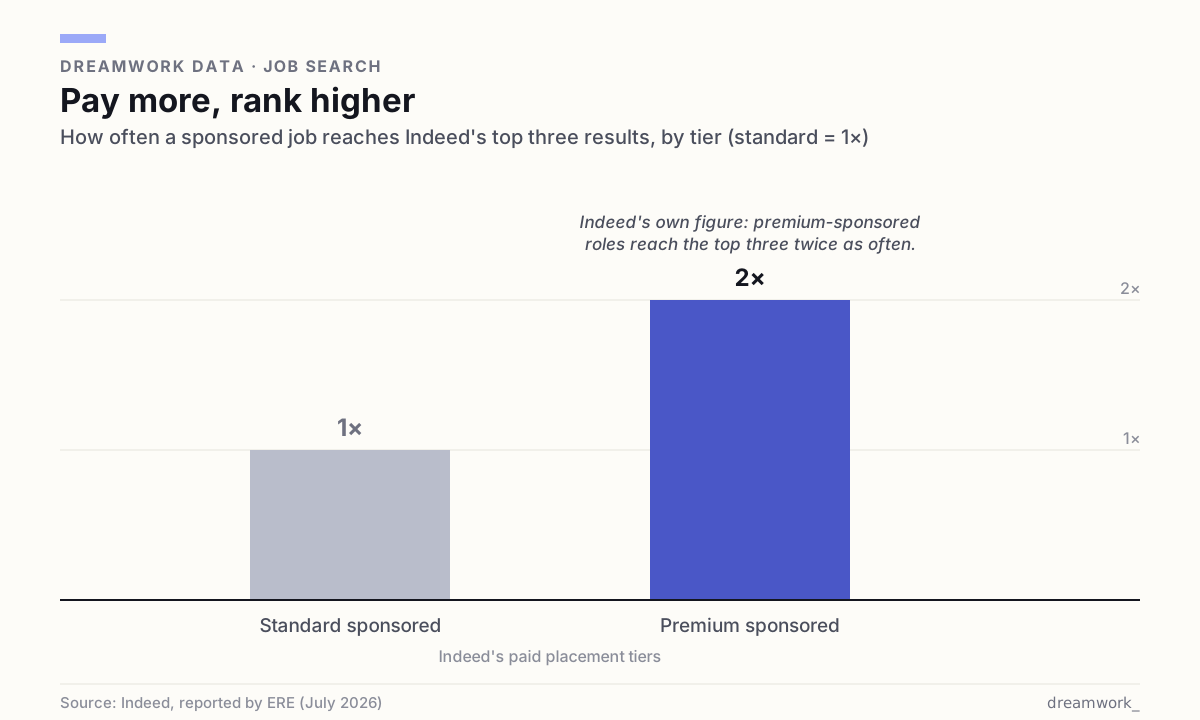
Two shifts explain most of it. The first is money. Indeed is free for job seekers because employers pay — and, increasingly, they pay to be seen. Sponsored listings sit at the top of results, and there are tiers: by Indeed's own disclosure, Premium Sponsored Jobs appear in the top three search results twice as often as Standard Sponsored ones. The top of your results is, in part, an auction.
The second shift is personalization. Indeed no longer just matches your keywords; it blends them with your history, your inferred skills, and your behavior on the site. Here is how the company itself puts it: two people searching for the same employer, title, or location 'may see different results.' That is a feature if the algorithm reads your mind. It is a problem if it doesn't — because when the ranking is opaque, you can't tell the difference between a role that isn't there and a role the system decided not to show you.
None of this makes Indeed a villain. A free-for-seekers marketplace has to earn money somewhere, and paid placement is how the whole job-board industry has always paid rent. But the cumulative effect is a search that increasingly serves the people who fund it — and those people are employers with ad budgets, not you.
You're not imagining it
The clearest sign that something shifted is that the people who hire are frustrated too. In a recent ERE report, an HR leader at a 7,500-person restaurant franchise described posting a role and searching for it the way a candidate would: 'Panera, Spring Texas.' You cannot get more specific than a brand and a town. The results still missed. Her ask was almost plaintive: 'I just want the search tool to work as it should.'
When the employer paying to list the job can't find the job, the search isn't serving anyone in the room. It's serving the ranking.
Job seekers have been saying this for longer, and the complaints are familiar to anyone who ran a search this year: reposts of roles filled months ago, 'remote' queries that return on-site work three states away, ghost jobs that exist to collect resumes. Volume was always Indeed's strength. In 2026 the volume is the problem — because without a search you can trust to sort it, a bigger haystack just hides the needle better.
The industry is saying it out loud
What's new is who's willing to say so. In July 2026, ERE — the publication talent-acquisition leaders have read since 1998, run by its founder and CEO David Manaster — published a piece with a blunt thesis right in the title: Indeed's search experience is creating an opening.
When the trade press that covers the hiring industry starts writing about the incumbent's decline, it isn't a disgruntled forum thread anymore. It's the market noticing. The piece walks the same pattern — opaque ranking, sponsored pressure, a search that stopped feeling like search — and asks the obvious next question: if the front door is broken, who builds a better one?
Where the opening is
Here's the useful way to think about the alternatives. A job hunt has two halves — finding the role, and applying to it — and almost every tool quits after the first.
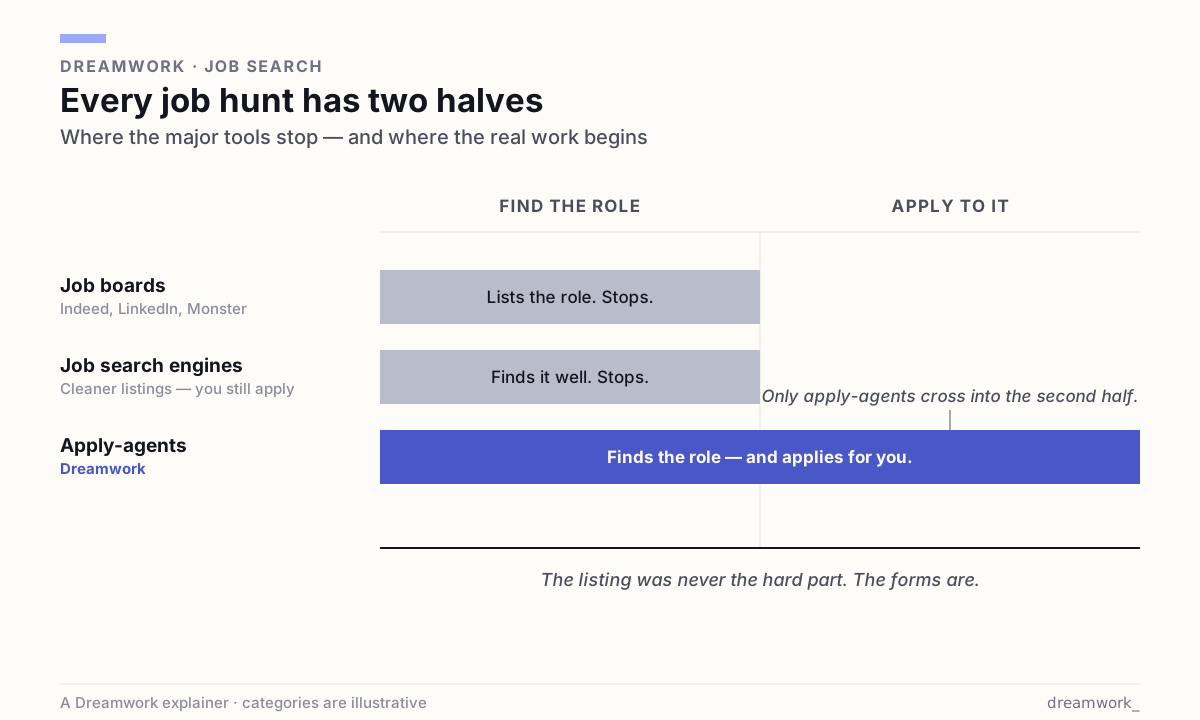
On the discovery side, a new class of job search engines rebuilt the part Indeed forgot. Hiring Cafe indexes company career pages directly, offers filters most boards never bother with, and — critically — takes no money to move a listing up. It's the cleanest free search on the internet right now. Our own live index works the same way: roles pulled from company sources, with no paid placements, and our AI job search ranks them by how well they fit you.
But finding the role was never the hard part. The hard part is the two hundred forms — the resume you retype, the same eight questions, the cover letter, the applicant tracking system that asks for your work history right after you uploaded a resume that contains it. That's the second half, and it's where the hours of a real job hunt actually go. It's also where Dreamwork picks up: it reads your resume, ranks live roles by fit, writes a tailored resume and cover letter for each, and — once you've reviewed them — can submit the application for you.
We aren't going to tell you Indeed is dead. It isn't. For hourly, local, and non-tech work, its scale is still unmatched, and plenty of people find jobs there every day. But for a focused search — especially in tech — the honest move in 2026 is to stop treating one broken search box as the whole map.
What to do about it right now
You don't have to wait for Indeed to fix its ranking. Four things help immediately:
- Go to the source. When you find a company you like, apply on its own careers page — you skip the reposts and the ghost jobs in one move.
- Use a real search engine for discovery. A tool that indexes company sites and takes no ad money shows you roles in order of fit, not budget.
- Stop answering volume with volume. Blasting 300 generic applications is a response to a broken funnel, not a strategy — the data shows offer rates actually fall past a point. Fewer, more tailored applications win.
- Hand off the busywork. If the finding and the form-filling is what's eating your week, that's exactly the part worth giving to software.
If you want the wider picture of where hiring is actually happening — which companies are adding roles, where the market is thin — our AI Labor Index tracks it, and our Dreamwork vs Indeed breakdown lays out the difference role by role.
The bigger picture
The story here isn't really about one company's search algorithm. It's about what happens when the infrastructure of finding work gets optimized for the people who pay for it instead of the people who use it. For twenty years we accepted that the front door to the labor market would be owned by an advertising business, and we called the results 'search.'
The opening ERE described is the crack that appears when enough people notice. The next front door won't be a bigger list. It will be a search that answers the question you actually asked — and, increasingly, an agent that walks through the door with you. You're not failing at the job hunt. The tool you were handed stopped working, and better ones now exist.
Frequently asked questions
Is Indeed getting worse in 2026?
The index is as large as ever, but the search experience has degraded for many users. Sponsored placement and opaque, personalized ranking mean the most relevant role often isn't on top — and two people running the same search can see different results. The listings are there; surfacing the right one got harder.
Why are Indeed's search results so irrelevant?
Two reasons. Paid 'sponsored' listings occupy prime positions, and Indeed blends your keywords with inferred skills and behavior, so results drift from exactly what you typed. When a search for a specific title and city returns roles that are neither, that mismatch is usually the ranking, not you.
What are Indeed's sponsored jobs?
Sponsored jobs are paid placements employers buy to appear higher in results. There are tiers: by Indeed's own disclosure, Premium Sponsored Jobs reach the top three results about twice as often as Standard ones. It's a normal way for a free-for-seekers board to make money — but it means budget influences the order you see.
What is the best alternative to Indeed?
Both halves of the search now have a better tool than Indeed. For finding roles, company-sourced search engines like Hiring Cafe show listings ranked by fit with no paid placements. For the applying itself, an apply-agent like Dreamwork ranks live roles to your resume and prepares each application. Our Dreamwork vs Indeed breakdown covers the differences role by role.
Is Indeed still worth using?
Yes, in the right cases. For hourly, local, and non-tech roles, its scale is still unmatched. For a focused search — especially in tech — pairing a cleaner discovery tool with something that handles the applications will save you more time than fighting the ranking on one platform.