LazyApply Review 2026: The Price, Caps and Refund
The lifetime deal is gone, the plans renew every year, and the refund closes after 100 applications.
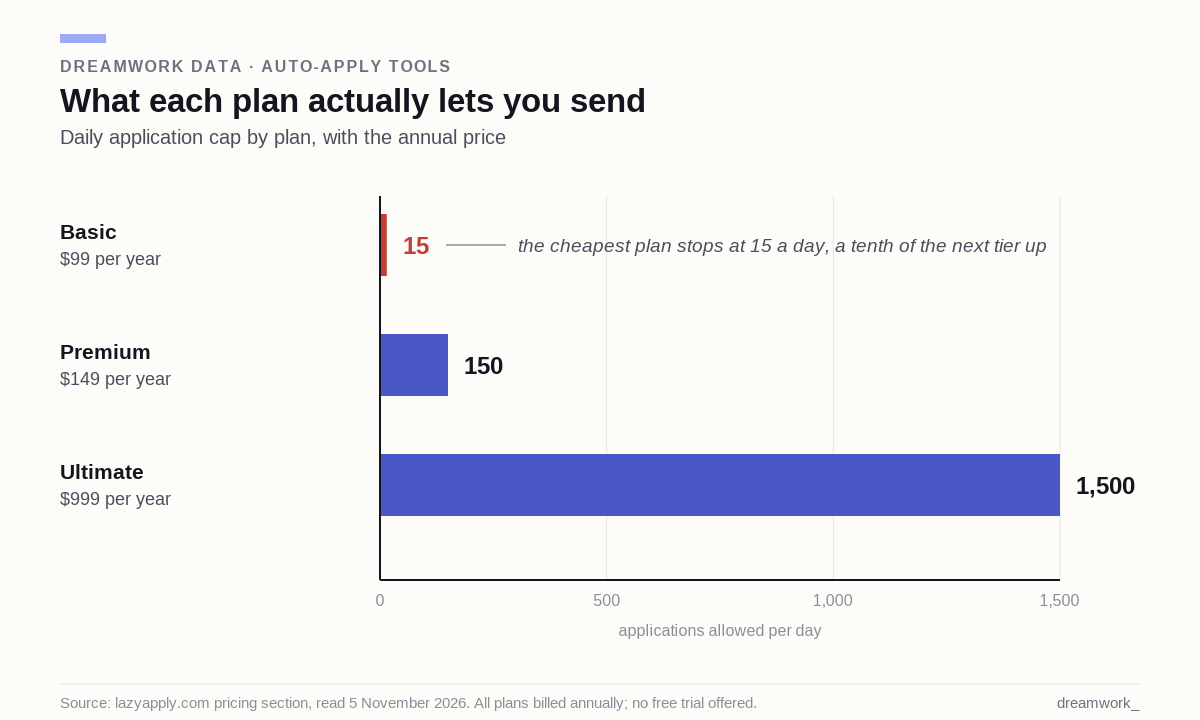
LazyApply is a maintained job-application extension: version 0.8.95 shipped on 26 October 2026, and its Chrome listing shows 20,000 users. It sells annual plans only, $99, $149 or $999 a year, with daily caps of 15 to 1,500 applications. Its Trustpilot score is 2.1 from 110 reviews, and its refund closes after 100 applications. Dreamwork is the better pick if you want each application written for the role.
How this review was done
A job search that has stopped answering makes volume look like the only thing left to push on. LazyApply sells volume more bluntly than anything else in the category. Its extension is listed as a job application bot, its top plan advertises 1,500 applications a day, and its name tells you exactly which objection it expects to hear.
This review is built from public evidence rather than a paid account: LazyApply's own pricing, FAQ, refund and terms pages, its Chrome Web Store listing, its Trustpilot profile and dated third-party reviews. We first wrote it on 16 August 2026 and re-read every page on 5 November 2026. We have not bought a plan, so nothing here is a test report, and where a claim could not be verified we say so instead of guessing.
The scores below come from the criteria and weights we publish under how we compare, applied the same way to every tool, and the cells there link every finding to the page it came from.
What LazyApply is in November 2026
LazyApply is a browser extension attached to a web dashboard. You build a profile once, point it at job boards, and its agent fills and submits applications on your behalf, with an analytics view and an automated referral-email feature alongside. Its homepage names three large job boards and one widely used applicant tracking system as places it applies.
It is a real, running business. The Chrome Web Store listing shows version 0.8.95, updated on 26 October 2026, with 20,000 users and 215 ratings. The terms of service say the company operates its service from offices in India, and its Trustpilot profile has been claimed since January 2022.
That distinction matters, because the usual failure mode in this category is not bad software. It is a vanished company. We looked at exactly that in our Sonara AI review, where the original startup closed and the domain changed hands. LazyApply's problems are a different set.
The lifetime deal is gone
For years the selling point was that you paid once. LazyApply ran a lifetime deal on AppSumo, now marked sold out, which still carries a 4.2 rating from ten reviews. Wobo's review, dated January 2026 and still online, lists three lifetime tiers: $99 for 150 applications a day, $149 for 300 a day, and $249 for a top plan with the daily limit removed. The same page also gives a second, different list, with a $129 plan at 750 a day, so even the lifetime pricing was never reported consistently.
That is not what is on sale now. LazyApply's FAQ answers the billing question in five words: "You will be billed annually." The same page says there is no free trial. Its pricing section, read on 5 November 2026, lists three yearly plans, each beside a higher struck-through price.

| Plan | Listed in January 2026 (Wobo) | Listed on 5 November 2026 (LazyApply) |
|---|---|---|
| Basic | $99 lifetime, 150 a day | $99 a year, 15 a day, 1 resume profile |
| Premium | $149 lifetime, 300 a day | $149 a year, 150 a day, 5 resume profiles |
| Top tier | $249 lifetime, no daily limit | $999 a year, 1,500 a day, 20 resume profiles |
Read the middle column against the right one. The two lower headline prices did not move. What changed is that they now repeat every year, and the entry plan's daily cap fell from 150 to 15. The top tier went from $249 once to $999 a year. The January figures are the first of Wobo's two lists, and we have not confirmed either against an archived copy of LazyApply's own page, so treat them as third-party reported.
One trace of the old model survives in plain sight. The extension's Chrome Web Store description still invites you to automate your applications "with the lifetime job application system LazyApply."
The refund clause that closes at 100 applications
The pricing section promises a 30-day money-back guarantee in capital letters. The refund policy linked underneath is narrower than that phrase suggests, and it is worth reading before you pay. Four conditions apply at once.
- The request must arrive within 30 days of the initial subscription date
- It covers initial subscriptions only, not renewals
- You must have applied to fewer than 100 jobs
- The product must "demonstrably fail to function as advertised," and you may be asked for evidence
The hundred-application ceiling is the one that bites, because it is measured in the currency the product is sold in. The Premium plan advertises 150 applications a day. Use it as advertised for a single day and you are past the refund threshold with 29 days of the guarantee still showing on the calendar. On the top plan you would cross it inside two hours.
None of this is hidden. The FAQ repeats the 100-job condition, and the policy is linked from the pricing section. It is a guarantee that expires on a different clock from the one it advertises, and the fast clock is the thing you are paying for. Our Sonara AI review found the same shape at a different vendor, where the trial ends on the eleventh application rather than the fourteenth day.
The terms of service are conventional for the category, and worth knowing anyway. The service is provided "AS IS" and "AS AVAILABLE" with no warranty that it will be uninterrupted or error-free, total liability is capped at the amount you actually paid, and disputes go to binding arbitration after a 60-day negotiation period.
Three ratings, three different numbers
LazyApply's homepage shows 4.9 beside a line claiming over 50,000 users. In August the same line said more than 10,000. No review count is attached to the 4.9 and no source is named for either figure. Two independent pages carry a rating for the same product, and neither of them says 4.9.
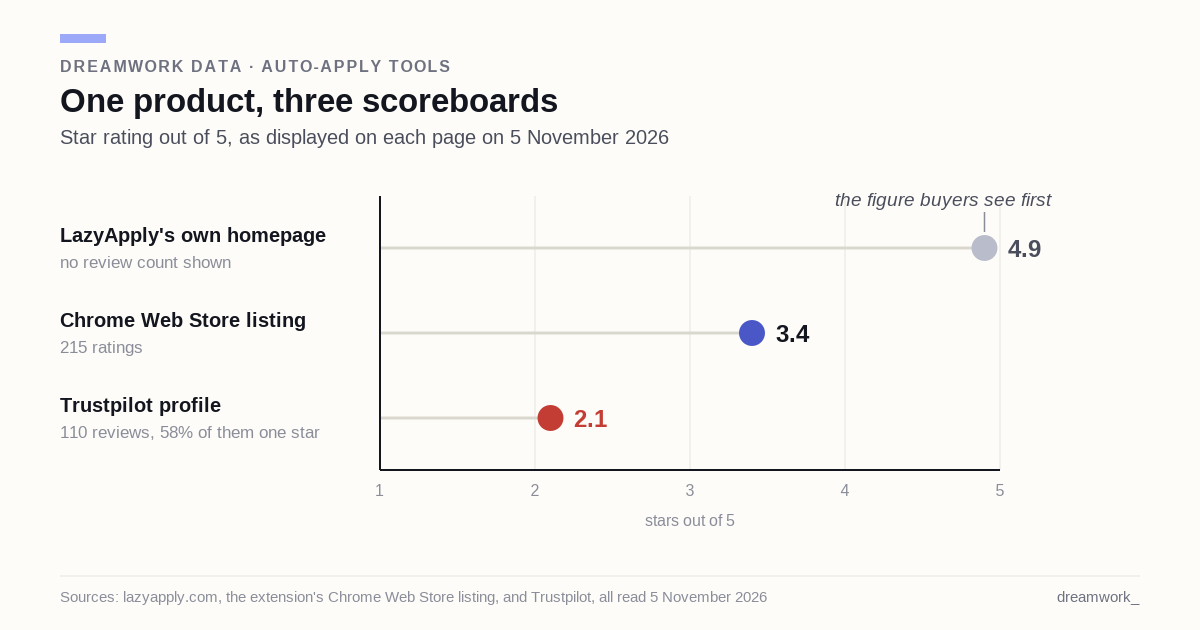
The Chrome Web Store shows 3.4 out of 5 from 215 ratings, which for a paid automation tool is unremarkable rather than damning. Trustpilot shows 2.1 from 110 reviews, labelled Poor, with 58% at one star and 37% at five. The middle is nearly empty: one four-star review and one three-star review.
Two caveats run in LazyApply's favour. A hundred and ten reviews against 20,000 extension users is a thin sample, and Trustpilot counts only 9 of them in the last twelve months. Trustpilot also notes that the company hasn't invited customers to review recently, so the profile is built from people who went looking, and people who go looking are rarely the satisfied ones.
One caveat runs the other way. The same profile says the company hasn't replied to negative reviews. In our JobCopilot review we gave a vendor credit for answering its critics in public. A silent profile is the version of that page without the credit.
What buyers actually report
The complaints cluster around customer service, form mistakes and refunds. The most detailed recent entry is worth reading closely.
William Andrés Castellanos, writing on 25 June 2026, reported paying and then never being able to use the product at all, because "their platform only works with Gmail accounts." The review describes signing up with a Hotmail address, being locked out, and sending more than three support emails offering to switch, then "absolute silence. Not a single reply."
That restriction is real and it is on the page today: every plan's email field is headed by a note, in bold, that the address must be a Gmail account. It is easy to read past on the way to the button, and the review describes finding out only after paying.
Form accuracy is the other recurring theme. Dobson Dunavant, in a three-star review from August 2024, described the tool getting "hung up on things as simple as 'Enter Today's Date.'" Jason Gunner, in June 2026, wrote that the platform "made consistent mistakes when applying for jobs" and described asking for a refund inside the 30-day window.
The positive reviews are real, and the best of them are specific about the limits. Terry Lee, in a five-star review from March 2022, called it "a massive time saver" and volunteered that it works on quick-apply flows rather than long applications. That is the honest description of this product: a fast path through the applications that were already easy to send.
Practitioner threads are more sceptical of the idea than of the software. On Blind in April 2024, replies to a question about these tools ran to "they produce tons of garbage applications" and a warning that they flood the same applications as hundreds of other people. On a levels.fyi thread about LazyApply specifically, none of the replies visible without an account came from someone who had used it. Our read of the research on how many applications it takes found offer rates falling once you pass roughly 80.
The risk nobody prices in
LazyApply's homepage makes an unusual promise about safety. It says its algorithms mean "your profiles will never get blocked by platforms." No job site has agreed to that on the record, and the sites are the ones who decide.
The largest professional network's user agreement prohibits members from using "bots or other unauthorized automated methods to access the Services," and reserves the right to "restrict, suspend, or terminate your account" for breaches. The exposure sits with the account holder rather than the vendor, and LazyApply's own liability is capped at the amount you paid.
The extension also discloses, in its store listing, that it handles personally identifiable information, authentication information, personal communications, location, user activity and website content. That is unavoidable for software that logs in and applies for you, and every tool in this category does something similar. It is still a large amount of access to hand to a product you cannot try before paying.
Where LazyApply wins
- Raw volume. Premium allows 150 applications a day and Ultimate 1,500. No other tool in our ranking advertises a higher cap.
- Volume on the entry plan. Basic's 15 a day is about 450 a month, more than the 50 Dreamwork's Pro plan sends.
- One payment a year. If you know you will search for months, one annual charge is simpler than a monthly bill. Dreamwork bills monthly or quarterly.
- Breadth. It applies across job boards and applicant tracking systems in every industry. Dreamwork covers professional roles in any function, not only tech, but isn't tuned yet for the frontline, healthcare and trades jobs it lists.
LazyApply vs Dreamwork
| Dreamwork | LazyApply | |
|---|---|---|
| Free plan | A tailored resume and cover letter for 3 jobs a day; you apply yourself | None, and no free trial |
| Applies for you | Apply and Autopilot, on paid plans | Its agent submits in bulk, on every plan |
| Review before it sends | Optional: set Apply to Review first | Its pages don't describe a review step |
| Resume per job | Written for every role, on every plan | 1, 5 or 20 stored resume profiles by plan |
| Volume on the cheapest paid plan | 50 applications a month on Pro | 15 a day on Basic |
| Price | Free to start. Pro is $99 a quarter (about $33 a month) or $39 month to month | $99, $149 or $999 a year |
| Runs from your AI assistant | MCP server; confirms before each send | No MCP server or API on its site |
| Scores from our November 14, 2026 check, with cover letters read November 19, 2026 | 95 of 100, the highest; our #1 pick | 47.5 of 100 |
New accounts can try Pro free for 7 days, then it's $39 a month unless you cancel. The trial is on monthly billing, one per account, and checkout asks for a card.
The ranking shows how each finding above scored, criterion by criterion, with the page it came from.
So, is LazyApply worth it in 2026?
It is legitimate, it is maintained, and it is unusually honest about being a volume tool rather than a matching one. Whether it is worth $99 turns on what you are actually short of. If you have a good list of roles with quick-apply flows and no hours in the day to send them, this sends them. If the problem is that nobody is replying, more submissions will not fix it, and LazyApply does not claim they will.
- Check the date on any LazyApply review you read, because anything before mid-2026 may describe lifetime pricing that is no longer sold
- Treat the refund as a 100-application window rather than a 30-day one, and decide inside the first day on the middle plan
- Use a Gmail address, because the checkout requires one and reviewers report being locked out otherwise
- Buy the Basic plan only if 15 applications a day is genuinely enough, since that is one tenth of the next tier
- Watch the first run closely for wrong dropdown answers and half-completed forms, the most common complaint by far
- Track replies rather than submissions, because submissions are what the price is set on
Pick Dreamwork instead if you want each application written for the role, with the choice to read every one before it goes. We set the two side by side in Dreamwork vs LazyApply, and LazyApply alternatives adds the other tools people use instead, including JobCopilot. None of it is a prerequisite for looking: our how-to guides cover the same ground for free, and you can look at the roles yourself today.
Frequently asked questions
Is LazyApply legit?
Yes. LazyApply is a real, maintained product: its Chrome extension was updated to version 0.8.95 on 26 October 2026 and its listing shows 20,000 users, and the company has held a claimed Trustpilot profile since January 2022. The fair cautions are its 2.1 Trustpilot score from 110 reviews and a refund policy that only covers you until your hundredth application.
How much does LazyApply cost in 2026?
LazyApply charges $99, $149 or $999 a year, billed annually with no monthly option and no free trial. The plans allow 15, 150 and 1,500 applications a day. Those figures come from the pricing section of lazyapply.com and its FAQ, both read on 5 November 2026.
Does LazyApply still have a lifetime plan?
No. LazyApply's FAQ says you will be billed annually, and its AppSumo lifetime deal is marked sold out. A January 2026 review from Wobo still lists $99, $149 and $249 lifetime tiers, so a review older than mid-2026 may describe pricing that is no longer on sale.
Can you get a refund from LazyApply?
Only under four conditions at once. LazyApply's refund policy requires the request within 30 days of the initial subscription, applies to first subscriptions rather than renewals, requires that you have applied to fewer than 100 jobs, and requires that the product demonstrably failed to function as advertised. On the 150-a-day plan, one day of normal use exceeds the application limit.
Can automated job applications get your account restricted?
They can. The largest professional network's user agreement prohibits using bots or other unauthorized automated methods to access its services, and reserves the right to restrict, suspend or terminate accounts that breach it. LazyApply's homepage claims profiles will never get blocked, but the platforms make that decision, and the tool's own liability is capped at what you paid.
Is LazyApply or Dreamwork better for tech jobs?
For a tech search where you want each application written for the role, Dreamwork. For the highest daily volume across many boards and industries, LazyApply. Both tools' own pages are linked under Sources.
Sources
- LazyApply homepage: plan prices, daily caps, resume profiles, rating badge, users claim and Gmail requirement (read 5 November 2026)
- LazyApply FAQ: annual billing, no free trial, refund criteria (read 5 November 2026)
- LazyApply refund policy: 30 days, initial subscriptions only, fewer than 100 jobs (read 5 November 2026)
- LazyApply terms of service: as-is warranty, liability cap, arbitration, India operations (read 5 November 2026)
- Chrome Web Store: LazyApply extension, 3.4 from 215 ratings, 20,000 users, version 0.8.95 updated 26 October 2026 (read 5 November 2026)
- Trustpilot: lazyapply.com profile, 2.1 from 110 reviews, star distribution, reviews (Castellanos, Gunner, Dunavant, Lee) and reply behaviour (read 5 November 2026)
- AppSumo: LazyApply lifetime deal page, marked sold out, 4.2 from 10 reviews (read 5 November 2026)
- Wobo, January 2026: LazyApply listed with $99, $149 and $249 lifetime tiers (read 5 November 2026)
- LinkedIn User Agreement: prohibition on bots and automated access, account restriction rights (read 5 November 2026)
- Blind, April 2024: practitioner thread on automated job-application tools
- levels.fyi community thread: has anyone used LazyApply
- Dreamwork: how we compare AI auto-apply tools, criteria, weights and every scored cell