JobCopilot Review 2026: What It Costs and What Users Say
A sourced verdict on the auto-apply tool that published a manifesto against the thing it sells.
JobCopilot is a real, operating auto-apply tool that submits job applications for you daily. It is legit, not a scam. But its public price is quoted per day, its refund window covers only technical faults inside seven days, and its Trustpilot score sits at 3.0 from 106 reviews, split hard between five stars and one. Verify the checkout total before you pay.
The company that wrote rules against its own category
Search the word jobcopilot and you are not really searching for a brand. You are searching for a category. Tens of thousands of people a month type it the way they would type “dishwasher” — as the name of a thing they hope will save them. What they want to buy is relief from a task that has quietly become a second job: filling in the same fields, over and over, for employers who mostly never reply.
JobCopilot sells exactly that relief. It also, unusually, publishes a document arguing that the way most people use tools like it is wrong. That contradiction is the most interesting thing about this product. Full disclosure: Dreamwork builds an AI job-application agent, so we compete with JobCopilot directly and have an obvious interest in what you conclude. We will keep it sourced. If you want to see the open market before you pay anyone, you can browse live roles first.
What JobCopilot actually is
JobCopilot is a job-application automation platform, based in France and live since at least mid-2024. You upload a resume, answer screening questions once, set filters, and a “copilot” finds matching roles each day and fills in the applications. Its homepage, as of July 2026, promises “10X more Job Interviews” and says it applies to jobs “from 500,000+ companies worldwide,” with “100,000+ users currently automating their job applications.”
- Daily automated applying, with an option to review each one before it is submitted
- Automatic resume tailoring per role on the higher tier
- AI resume builder, cover-letter builder, and mock interviews
- An application tracker dashboard covering everything the copilot sent
- Purchasable credits that reveal hiring-manager email addresses for follow-ups
- A browser extension that autofills applications you find yourself
The stated safety rail is source quality. JobCopilot says it “exclusively applies to verified jobs on official company career pages,” framing that as protection: “No more worrying about fake listings.” It is a fair pitch and a real differentiator from tools that pull from open boards where ghost jobs accumulate. Whether it holds in practice is where users disagree.
What JobCopilot costs in July 2026
Here is the first thing to understand, and we checked it live on 25 July 2026: JobCopilot's public pricing page does not show a monthly price. It shows a daily one. Premium reads “starts from $0.93 per day.” Elite reads “starts from $1.05 per day.” Underneath, a single line notes that “Weekly, Monthly and Quarterly plans available” — without saying what any of them cost.

Ninety-three cents a day is a true number and an unhelpful one. Elsewhere on its own site, JobCopilot's FAQ says “Our plans start at $8.90.” Independent reviewers who priced the checkout report the following spread, which depends entirely on whether you commit weekly or quarterly.
| Plan | What the page shows | Reported real billing | What you get |
|---|---|---|---|
| Premium | from $0.93 / day | about $8.90 a week, or roughly $28–$39 a month | 1 copilot, up to 20 job matches daily |
| Elite | from $1.05 / day | about $12.90 a week, or roughly $31–$56 a month | 3 copilots, up to 50 daily, resume tailoring, hiring-manager credits |
There is no free trial. A promo page offers a code for 50% off the first month only, after which, in JobCopilot's own words, “your subscription continues at the regular monthly rate.” And the pricing appears late: one reviewer, Lori Webb, wrote in June 2026 that she “Spent an hour filling out forms just to be told at the end ‘subscription’.” JobCopilot replied publicly that it had passed her suggestion to its product team.
The refund window is narrower than reviewers describe
Several third-party reviews describe a “7-day money-back guarantee.” That is not quite what the terms say, and the difference matters. We read JobCopilot's Terms of Service on 25 July 2026. Section 6 reads: “Refunds, including partial refunds, may be offered only if JobCopilot is notified within the first 7 days from the start of the subscription of a technical issue that prevents proper use of the service.”
Read it twice. The clock is seven days; the trigger is a technical fault, not a bad outcome. If the software runs perfectly and applies to two hundred roles you would never have chosen, that is not, by the letter of this clause, a refundable event. In practice JobCopilot does make exceptions — one reviewer reports a partial refund in July 2026 — but the written policy is the floor you agree to, not the goodwill.
What users actually report
We read JobCopilot's Trustpilot profile directly on 25 July 2026. The headline number has moved: reviewers writing earlier in 2026 cited scores of 4.2 and 3.8, but the live TrustScore now stands at 3.0 out of 5 across 106 reviews, 73 of them in the last twelve months. The distribution is the story, and it is a strange one.
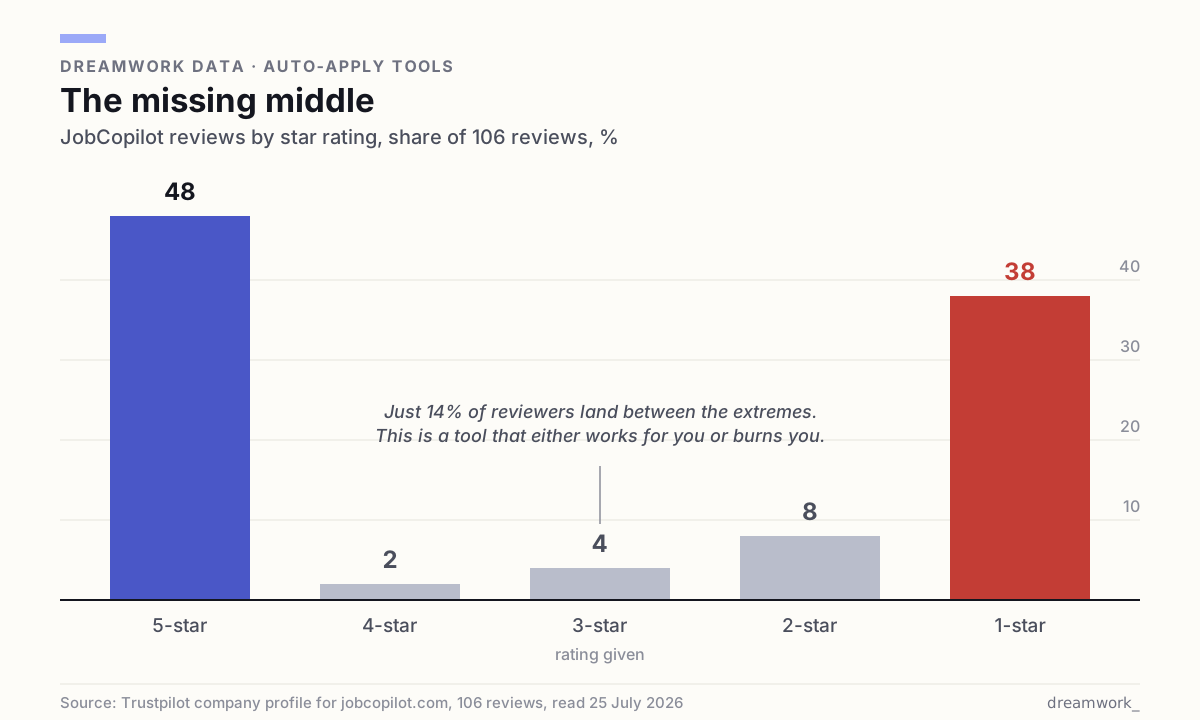
Almost half the reviews are five stars. More than a third are one. Only 14% sit anywhere in between. That is not the shape of a mediocre product; it is the shape of a product whose outcome depends almost entirely on who you are and what you asked it for. The complaints cluster around two opposite failures. Some users get far too many wrong applications. Jared Pfeifer, writing in July 2026, reported more than 500 applications with no contact and said the tool “directly disobeys simple filters like job title, location (even wrong countries), experience.” Others get far too few: Gabriele Zamò, a senior IT professional, reported just seven results in a month for his €18.
The most instructive review is neither. Shae Gruba wrote in July 2026 that JobCopilot submitted more than 300 applications in two weeks and felt “well worth the cost” — then, by week four, “the total had grown to nearly 600 applications, yet I hadn't received a single interview request, recruiter phone screen, or meaningful next step.” JobCopilot replied on the record that “interview outcomes ultimately depend on employer-side factors such as market conditions, competition, and hiring requirements.” That answer is true — and it is the whole problem with buying volume: the tool is paid on submissions, and you are paid on replies.
The positive reviews are real too, and specific rather than gushing. Spencer Ridgeway wrote in April 2026 that “sometimes it picks a job that is slightly off, but for the volume it sends, it's worth it. Got three responses so far.” Others praise the tracker dashboard and the way autofill removes the grind of retyping answers. Nobody who liked it called it precise. They liked that it was tireless.
The manifesto it wrote, and the product it sells
This is the part that makes JobCopilot genuinely more interesting than its competitors. It publishes a “Manifesto for Responsible AI Job Applications,” co-authored by one of its founders, which argues that “AI should amplify human intent, not act on its own” and that “Job applications are personal decisions that affect real lives, real companies, and real careers.” Its proposed framework is specific and, frankly, good:
- “Ban ‘mass apply’ behaviour (e.g. limit to 50 applications/day)”
- A “minimum matching score” threshold, suggested at 50%, “to prevent irrelevant applications”
- “No more than 3 applications per company per 6 months per user”
- Relevance checks on skills, location, title, and experience before any application goes out
- A visible matching rationale, so users can see why a role was chosen
- Truthful representation of the candidate, “without exaggeration or falsification”
Now hold that next to the product. The Elite plan's advertised maximum is up to 50 job matches a day. JobCopilot's own definition of banned mass-applying, and its top plan's daily ceiling, are the same number. The company is not breaking its rule — it is selling a product engineered to sit exactly on the line it drew. And the marketing argues for the volume the manifesto warns about: the homepage's case for automation is that “The average person needs to apply to 50 – 100 jobs just to get 1 interview.”
And the volume premise does not hold up. Our own read of the federal jobseeker data says the chance of an offer rises with applications only to a point and then falls: past roughly 80 applications, offer rates drop by about a third. The numbers are in our breakdown of how many applications it takes to get a job. Six hundred submissions is not six hundred chances. It is one profile, misfired six hundred times — and the applicant, not the tool, carries the reputational cost of every bad one.
Where it sits in its own category
Compared with the tools it is usually shortlisted against, JobCopilot's public standing is weak. Reading Trustpilot profiles across the category on 25 July 2026, it scores below every mainstream rival except one.
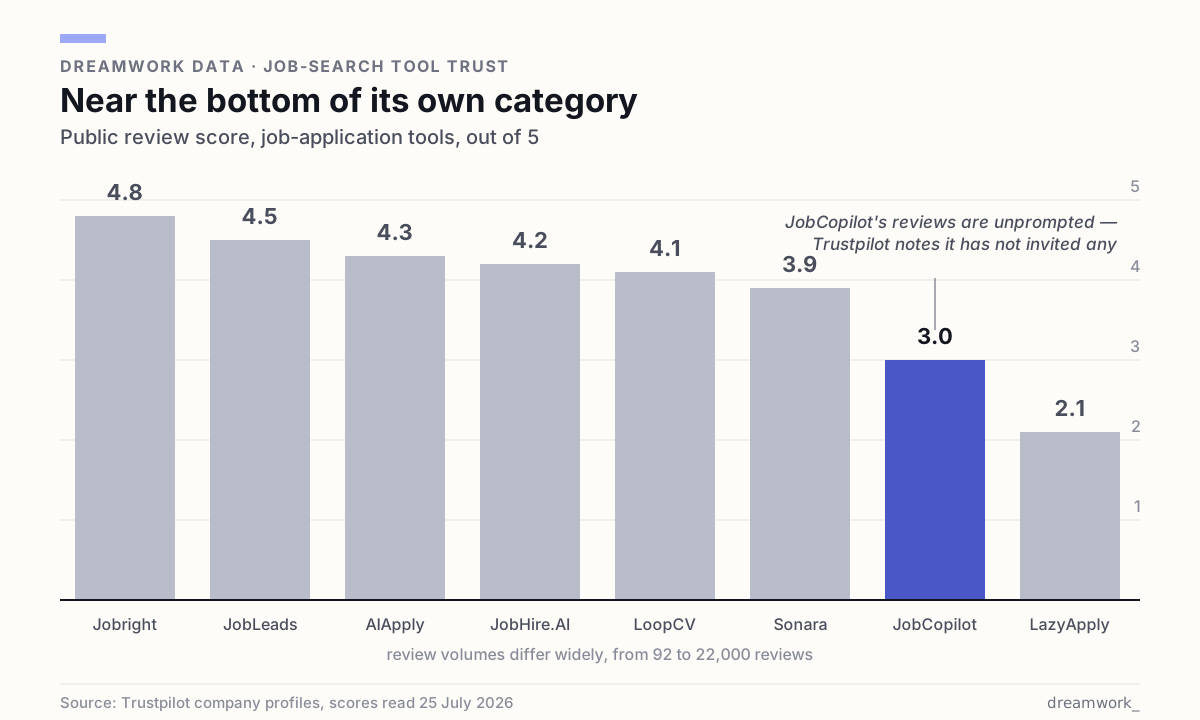
That chart deserves a caveat that cuts in JobCopilot's favour. Trustpilot flags on its profile that the company “hasn't invited customers recently, so reviews may not be representative” — meaning its 3.0 is built almost entirely from people angry or delighted enough to write unprompted. Several higher-scoring competitors actively solicit reviews, and one, as we covered in our AIApply review, carries a Trustpilot integrity notice about how it collects them. A 3.0 earned without invitations is not the same object as a 4.3 earned with them.
Credit where it is due, too: Trustpilot records that JobCopilot has replied to 97% of its negative reviews, typically within 48 hours. We read those replies. They are written by a person and they address specifics. That is markedly better behaviour than the unanswered complaint piles we found while writing our JobHire.ai review. A company that answers its one-star reviews is telling you something real.
So, is JobCopilot worth it?
It is legit — a real company with a real product, tens of thousands of users, a support team that answers, and an ethics position more considered than anything its rivals have published. Wobo's reviewers, who tested every feature, scored it 3.5 out of 5, and that feels honest. If you are applying broadly to high-volume roles, hate forms more than you fear misfires, and use review-before-submit rather than full autopilot, users in exactly that position report it working.
For everyone else, the case is thin, and the reason is not the software. It is the asymmetry. JobCopilot's cost to you is capped at about a dollar a day. Your cost, when it applies to the wrong role in the wrong country at the wrong seniority, is a hiring team's lasting impression of who you are. The tool never pays that bill. You do, quietly, in every future search.
- Buy the shortest billing period first. Never commit quarterly to something you have not watched apply for a week.
- Screenshot the checkout total and the renewal date — the price you compared was quoted per day, not per charge.
- Use review-before-submit, not full autopilot, at least until you trust what it selects.
- Narrow the filters far harder than feels comfortable. Every complaint about wrong roles starts with broad criteria.
- Track reply rate, not send count. Six hundred applications with zero replies is a warning, not a milestone.
- If something genuinely breaks, raise it inside seven days. After that the written policy is against you.
None of this needs a subscription to start. You can read our how-to guides and apply deliberately for free. JobCopilot's own manifesto says it best, and it is worth taking more seriously than the pricing page does: AI should amplify human intent, not act on its own. The tool that wins your search is not the one that applies fastest. It is the one that gets a human to write back.
Frequently asked questions
Is JobCopilot legit?
Yes. JobCopilot is a real, operating company with a claimed 100,000-plus users, a public terms of service, and a support team that Trustpilot records as replying to 97% of negative reviews within about 48 hours. It is not a scam. Its live Trustpilot score of 3.0 from 106 reviews as of July 2026 reflects inconsistent results, not fraud.
How much does JobCopilot cost in 2026?
Its public pricing page quotes Premium from $0.93 a day and Elite from $1.05 a day, with no monthly total shown. JobCopilot's own FAQ says plans start at $8.90, and independent reviewers report roughly $28 to $39 a month for Premium and $31 to $56 for Elite, depending on whether you bill weekly or quarterly. There is no free trial.
Can you get a refund from JobCopilot?
Only narrowly. JobCopilot's terms state that refunds may be offered only if it is notified within the first seven days of a technical issue preventing proper use of the service, and that later requests will not be eligible. That is a fault-based window, not a satisfaction guarantee, though some users report receiving partial refunds after raising a case directly.
Does JobCopilot's auto-apply actually work?
It submits applications reliably; the disagreement is about relevance. Trustpilot reviewers report both extremes: one described nearly 600 applications in four weeks with no interview request, another reported the tool ignoring filters on title, location and experience, while a satisfied user said it was worth it for the volume and had produced three responses. Use review-before-submit mode and narrow filters.
Is JobCopilot better than AIApply or JobHire.ai?
On public trust signals it currently scores lower — 3.0 on Trustpilot against 4.3 for AIApply and 4.2 for JobHire.ai as of July 2026 — but its reviews are unprompted while some competitors solicit theirs, and it answers its critics far more consistently. On features the three are close. Judge them on refund terms and filter control, not headline scores.
Why does JobCopilot publish a manifesto against mass applying?
Its Responsible AI framework argues that AI should amplify human intent rather than act alone, and proposes banning mass-apply behaviour above 50 applications a day, a minimum 50% match threshold, and no more than three applications per company per six months. The tension is that its top plan's advertised maximum is 50 job matches a day — exactly the line the framework draws.
Sources
- JobCopilot official pricing page (live per-day pricing, read 25 July 2026)
- JobCopilot homepage (interview, company-count and daily-application claims)
- JobCopilot — Manifesto for Responsible AI Job Applications
- JobCopilot Terms of Service — Section 6, Refund Policy
- JobCopilot reviews page — "Our plans start at $8.90" FAQ
- JobCopilot promo-code page — 50% off first month only
- Trustpilot — JobCopilot company profile, score and review distribution
- LoopCV — JobCopilot Review: Pricing, Ghost Jobs, and Honest Verdict
- Wobo — JobCopilot Review 2026: We Tested It
- 6figr — JobCopilot Review: Is It Worth Your Money in 2026?