Job Search Burnout in 2026: You're Not Failing
The exhaustion is real. So is the reason for it. Job search burnout is a rational response to a market that got measurably harder.
Job search burnout is the exhaustion, dread, and self-doubt that build after weeks of applying into silence. It is not a character flaw. The market changed: one opening now draws hundreds of applicants, most applications get no reply, and many postings were never real. First move: stop measuring effort by how many you send, and cap your daily volume.
The exhaustion is real, and it is not yours alone
You know the feeling before you can name it. You open the tab. You see the roles. Something in your chest tightens. You were going to apply to ten today and you cannot make yourself do three. The cursor sits in the cover-letter box. Nothing comes. You close the laptop and feel worse than before you opened it.
That is job search burnout. And the first thing worth saying, plainly, is that it is not a verdict on you. In a 2025 report compiling job-seeker research, 72% said searching for work hurt their mental health and 79% reported anxiety during the process. When most people doing a thing feel wrecked by it, the thing is broken, not the people.
This essay makes an argument with numbers behind it: your exhaustion is a rational response to a market that got measurably harder. Application volumes exploded. Reply rates collapsed. A large share of postings were never real. Then it gives you the honest, unglamorous self-defense that actually helps, because naming the machine is only useful if you also learn how to stop it from grinding you down.
What job search burnout actually is
Job search burnout is the emotional and physical depletion that comes from sustained effort with little or no feedback. It looks like dread before you apply, a shrinking ability to write yet another tailored letter, and a slow slide from "I haven't landed it yet" to "something is wrong with me." That last shift is the dangerous one. Burnout does not just tire you. It rewrites how you see yourself.
It is a close cousin to job search depression: flattened motivation, disrupted sleep, and a loss of the sense that your actions change anything. The clinical term for that last piece is learned helplessness, and it is exactly what a market engineered to swallow effort without reply will train into you. One 2025 tracker found that on any given week, the single most common emotion job seekers reported was simply feeling exhausted.
None of that means you are weak. It means the loop you are trapped in gives almost no signal back. Humans are wired to keep going when effort produces feedback and to fall apart when it does not. The modern job hunt is a near-perfect machine for withholding feedback. So let's look at why.
The funnel got harder: the numbers
Start with competition. Five years ago, a typical job posting drew about 100 applications. In 2026, the average opening pulls 242 applicants, and popular roles can gather hundreds within a weekend. The chance any single application becomes the hire has fallen toward a fraction of a percent.
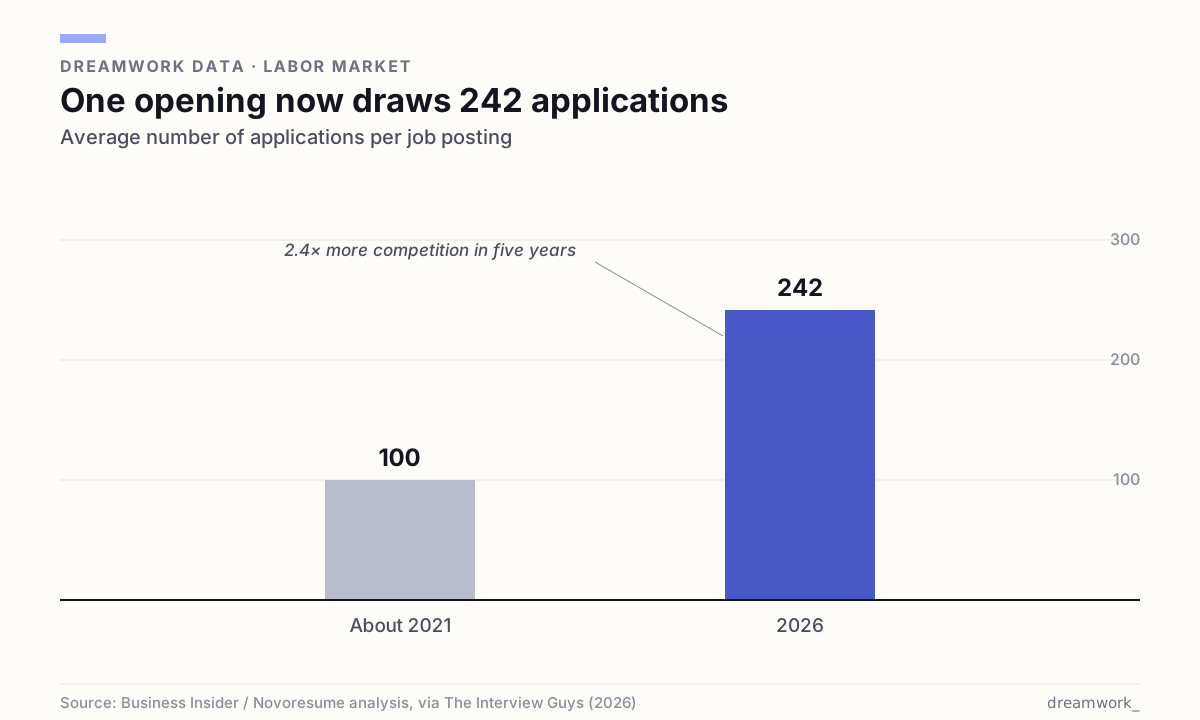
Why the flood? Applying became almost free. New tools let anyone fire off a polished application in seconds, so people apply to everything. One professional network reported roughly 11,000 applications submitted every minute, a 45% jump in a single year. When the cost of one more application drops to near zero, volume explodes, and every listing you touch is buried under hundreds of others.
On the employer side, the funnel narrowed to match. An analysis of more than 10 million applications across 60,000 businesses found that in 2024 the applicant-to-interview rate was just 3%, and employers received an average of 180 applicants for every hire. This is the part that matters for your sanity: you are not getting fewer replies because your resume got worse. You are getting fewer replies because the denominator quietly tripled. If you want the granular breakdown, we cover it in how many applications it takes to get a job.
Where your applications actually go
Here is the quiet cruelty of the current market: silence is the default outcome. Aggregated 2025 data suggests that roughly three of every four applications get no response at all — no interview, no rejection, no acknowledgment that a human ever saw it. The application does not fail so much as evaporate.
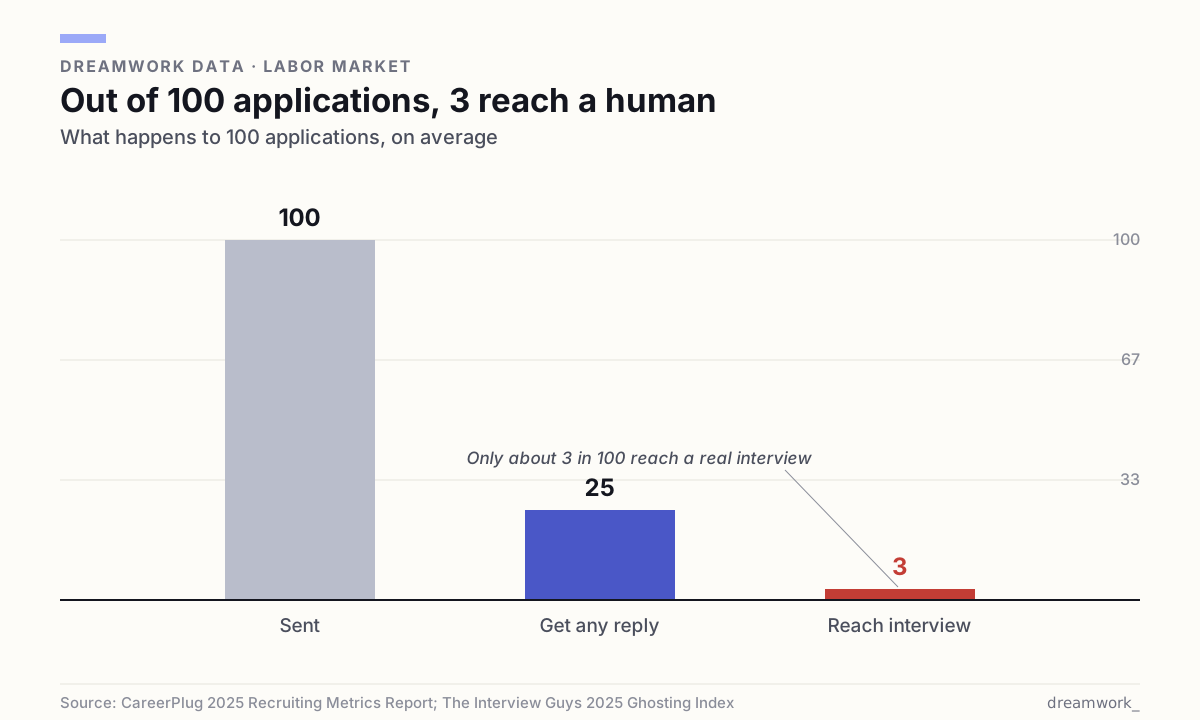
It gets worse the further you go. In one 2025 index, 61% of candidates reported being ghosted after an interview — after taking time off, prepping, showing up, and being told they were a strong fit. The people running the process are not villains one by one. They are drowning too. But the aggregate effect on you is a stream of effort that vanishes into a system that rarely closes the loop. If the waiting is the part breaking you, we wrote a whole piece on how long it takes to hear back after applying.
Ghost jobs: applying into rooms with no door
Now the part that should make you angry rather than ashamed. Some of the roles you are pouring yourself into were never going to be filled. A ghost job is a posting a company has no real, near-term intent to hire for — kept live to collect resumes, project growth, or keep a pipeline warm.
The scale is structural, not anecdotal. Tracking official labor data, one 2025 analysis found that U.S. employers reported 7.4 million openings in a single month but made only 5.2 million hires, leaving 2.2 million roles that led nowhere. The gap between postings and actual hires has held at roughly 28% to 32% every month since 2021, up from under 10% in the 2010s. A meaningful slice of the listings on your screen are doors painted on a wall.
This reframes the whole feeling. If you assume every listing is a genuine chance, then every silence reads as a personal rejection. Once you know that a large share were never openings at all, the silence stops being a report card. It is not that you failed 200 times. It is that a good number of those rooms had no one inside. We break down the tells in the guide to ghost jobs.
Why this breaks people, and why that is rational
Put the pieces together and burnout stops looking like fragility. You are asked to perform hope, repeatedly, into a system that returns almost no signal. You tailor, you research, you write, you submit. The market answers with silence three times out of four, ghosts you after interviews, and salts the ground with postings that were never real.
Any healthy nervous system burns out under those conditions. Effort without feedback is the textbook recipe for demoralization. The exhaustion you feel is not evidence that you are bad at this. It is evidence that you are a normal person responding normally to an abnormal amount of unrewarded effort. The shame is the misfire — it takes a structural problem and files it under personal failure.
So the real work is not to try harder. Trying harder inside a broken funnel just feeds the machine more of you. The work is to change what you measure, cap what the market can take, and refuse to let a rigged process set the terms of your self-worth.
How to defend yourself
This is self-defense, not a productivity hack. The goal is to survive the search with your health and your sense of self intact, and to spend your limited energy where it actually converts. Concrete moves:
- Cap your daily volume. Pick a number — five, eight, ten — and stop when you hit it, even if you have energy left. Uncapped applying is how a search eats your whole day and still feels like failure. A hard ceiling protects tomorrow's version of you.
- Measure replies, not sends. Track conversations started, not applications fired. Sends are effort. Replies are signal. A week with 3 real replies beats a week with 80 silent submissions, every time.
- Go narrow, not wide. Ten genuinely targeted applications to real, verifiable openings will out-convert a hundred sprayed ones — and cost you far less of yourself. Filter for roles that actually fit before you spend a single sentence on them; a curated feed like Dreamwork's AI job search exists for exactly this.
- Protect your self-worth from the funnel. A non-response is data about a saturated market, not a review of you as a person. Write that down somewhere you'll see it. Silence is the market's default setting, not a verdict.
- Build in real recovery. Schedule days fully off the search. Burnout is depletion; you cannot out-hustle it. Rest is not a reward for landing the job, it is the thing that keeps you able to keep looking.
- Get feedback from somewhere the market won't give it. Since the funnel withholds signal, create your own: a friend who reviews your resume, a checklist, a how-to library that tells you whether your materials are actually strong. Feedback is the antidote to learned helplessness.
The reframe that keeps you sane
The single most useful shift is to change your scoreboard. The market wants you to measure yourself by output — applications sent, hours logged, streaks maintained. That scoreboard guarantees burnout, because in a funnel this narrow, high output mostly produces high silence.
| Old scoreboard (burns you out) | New scoreboard (protects you) |
|---|---|
| Applications sent per day | Real conversations started per week |
| Hours spent applying | Quality of the handful you targeted |
| Streaks and volume | Energy left for the next good week |
| Every silence is a rejection | Silence is the market's default |
Adopt the right-hand column and two things change. Your effort points at the small number of applications that actually convert. And the market loses its grip on your mood, because you have stopped grading yourself on a metric the market rigged.
None of this makes the search easy. The funnel is still narrow, the ghosts are still out there, the silence is still loud. But you are no longer confusing a structural problem for a personal one. You are pacing yourself for a marathon that got longer through no fault of yours. You're not failing. The funnel is — and now you know how to keep it from taking you down with it.
Frequently asked questions
Is job search burnout a real thing or am I just being lazy?
It is real and it is common. In 2025 research, a majority of job seekers reported that searching harmed their mental health, and anxiety and exhaustion were the most-reported feelings. Burnout is depletion from sustained effort with little feedback — the opposite of laziness.
Why am I getting no responses to my applications?
Mostly because the funnel changed, not because your resume did. The average opening now draws 242 applicants, roughly three in four applications get no reply at all, and a large share of postings are ghost jobs with no real intent to hire. Silence is the market's default, not a verdict on you.
How do I deal with job search burnout right now?
Cap your daily applications to a fixed number, schedule real days off, and switch your scoreboard from applications sent to conversations started. Go narrow and target verifiable openings instead of spraying. And separate a non-response, which is data about a saturated market, from your worth as a person.
How many applications is normal before landing a job?
There is no single number, but the odds per application are low: one large dataset put the applicant-to-interview rate around 3% and about 180 applicants per hire. Expect to send many, and judge your progress by replies and interviews rather than raw send count.
What are ghost jobs and how much do they matter to my burnout?
Ghost jobs are listings a company has no near-term plan to fill. Official labor data shows a persistent 28% to 32% monthly gap between openings reported and hires made. They matter because they make silence feel personal when a chunk of the rooms you applied to had no one inside.
Can taking a break hurt my job search?
A short, deliberate break helps far more than it hurts. Burnout is depletion, and you cannot out-work it. Rest restores the focus you need to write strong, targeted applications, which convert better than a large volume of exhausted, generic ones.
Sources
- eWeek — LinkedIn / New York Times: 11,000 job applications per minute, up 45% (June 2025)
- The Interview Guys — The Average Job Opening Now Gets 242 Applications (2026)
- CareerPlug — 2025 Recruiting Metrics Report (3% applicant-to-interview rate; 180 applicants per hire)
- The Interview Guys — State of Job Search 2025 Research Report (72% mental-health impact; 79% anxiety)
- The Interview Guys — 2025 Ghosting Index (75% of applications get no response; 61% post-interview ghosting)
- HR Dive — 1 in 3 US job listings go nowhere, creating a 'ghost job economy' (Nov 2025)