Is LinkedIn Premium Worth It? The 2026 Math, Done Out Loud
Everyone answers "it depends." Here is the arithmetic: the price, what it buys, and the exact break-even.
LinkedIn Premium Career costs $39.99 a month in the US as of July 2026, or $239.88 prepaid for a year. Priced against lost wages, it only has to shorten a median 68.5-day search by half a day to break even — a very low bar. But no independent study has measured whether it does, and LinkedIn's own claims date from 2022 to 2024. Buy monthly, or skip it.
The honest answer is arithmetic, not opinion
Almost every article about LinkedIn Premium ends in the same place: it depends. That answer costs nothing to write and is worth exactly that. So let's run the numbers out loud instead. The price is public, the base rates of a job search are published, and the break-even is a division problem. Work it through and you find something more uncomfortable than a scam: a cheap product wrapped in an expensive silence.
Full disclosure: Dreamwork builds an AI job-application agent, so LinkedIn Premium and this site compete for a slice of the same job-search budget. Every judgment below is shown as working you can check. Where the evidence runs out, this piece says so rather than filling the gap with vibes.
The short version, before the working. Premium Career costs $39.99 a month in the US as of July 2026. Priced against what a month of not working costs you, that is trivially cheap — it needs to shave about half a day off a ten-week search to break even. The price was never the problem. Nobody has published independent evidence it moves the number at all.
What LinkedIn Premium costs in July 2026
Prices first, because half the internet is quoting stale ones. Every figure below was read off LinkedIn's own plan pages on 25 July 2026 — US list price, before tax.
| Plan | Billed monthly | Prepaid for a year | InMail credits |
|---|---|---|---|
| Premium Career | $39.99 | $239.88 ($19.99/mo) | 5 per month |
| Premium Business | $69.99 | $539.88 ($44.99/mo) | 15 per month |
| Premium All-in-One | $89.99 | $899.88 ($74.99/mo) | Not published |
| Sales Navigator Core | $119.99 | $1,079.88 ($89.99/mo) | 50 per month |
| Sales Navigator Advanced | $159.99 | $1,799.88 ($149.99/mo) | 50 per month |
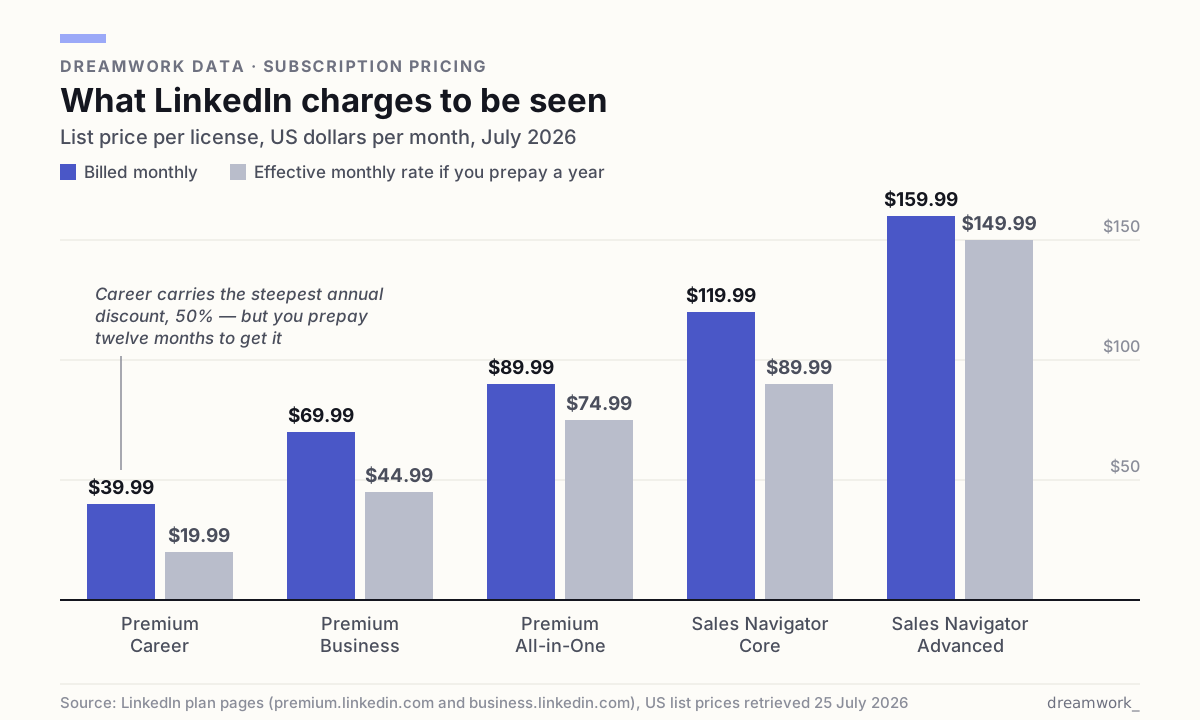
Only one of those is built for you. Premium Career is the job-seeker tier; Business is for outbound; Sales Navigator is a sales tool job seekers occasionally buy for its filters and 50 monthly InMails. If someone tells you to buy Sales Navigator to find a job, they are recommending a $119.99-a-month subscription to solve a problem the $39.99 one was designed for.
One caveat LinkedIn prints itself: prices are estimates that may exclude tax and promotional discounts, vary by country, and are subject to change. Check the number at checkout, not in an article — including this one.
What $39.99 a month actually buys
Divide the price by what you actually receive and the product becomes legible.
- 5 InMail credits a month — $8.00 per message at the monthly price, $4.00 if you prepay a year. LinkedIn credits one back for every InMail accepted, declined, or replied to within 90 days, so messages that land cost less than messages that vanish.
- 3 Top Choice jobs a month — $13.33 each. You flag a posting as a top choice and attach a note saying why. It only works on Easy Apply postings, and credits refresh monthly rather than accumulating.
- Top Applicant — a badge that appears only when you rank in the top half of applicants on a role with at least 10 applicants. Read that carefully. It tells *you* where you stand; LinkedIn's help page does not claim it changes what the employer sees.
- Who viewed your profile, going back 365 days, plus private browsing.
- LinkedIn Learning — 25,000-plus courses, a genuinely good product and the most underrated thing in the bundle.
Add it up and the fee buys eight outbound actions a month — five messages, three flags, about $5 apiece — plus a dashboard. That is the whole machine. Note the asymmetry: the features that could plausibly change an outcome are the ones you spend, and there are only eight. The rest just show you numbers about yourself.
One detail worth knowing before you subscribe: cancel, and any unused InMail balance drops to zero. The credits are not yours. They are a lease.
What LinkedIn claims, and what those claims are made of
LinkedIn does publish outcome numbers, and they are not modest. From the Premium Career page in July 2026: members are 2.6x more likely to get hired and 39% more likely to hear back after applying; Top Choice users are 43% more likely to get a recruiter reply; people who InMail a job poster are 1.6x more likely to hear back and 3x more likely to get hired; subscribers get 11x more profile views.
Now read the footnotes, which to LinkedIn's credit are printed right there. Every one of those figures is attributed to "LinkedIn data," dated January 2022, October 2022, April 2023, and January 2024. Not one is from 2025 or 2026. A subscription sold today is marketed on measurements from a hiring market that no longer exists — before the collapse that dragged the applicant-to-interview ratio down to about 3% across 10 million-plus applications (CareerPlug, 2024).
The deeper problem is not staleness. It is selection. People who pay $40 a month for a job-search tool are, by construction, in the middle of a serious search. They apply more and message more. Attributing the gap to the subscription is like noting that people who buy running shoes finish more marathons. LinkedIn has the data to do this properly. It has not published a comparison that controls for effort.
The strongest independent evidence about LinkedIn and employment is not about Premium at all. A randomised trial in *American Economic Journal: Applied Economics* (2022) found that training job seekers to join and use LinkedIn raised the end-of-programme employment rate by 10 percent — 7 percentage points — persisting at least 12 months. That is real, causal, independent evidence, and it is about *using* the platform. No one has run the equivalent study on *paying* for it.
The break-even, out loud
So let's build the break-even ourselves, from pieces we can verify. Start with duration. Median time to a first offer was 68.5 days in Q2 2025 across 461,000 tracked applications — about 2.25 months. At the monthly price, that search costs 2.25 × $39.99 = $90.02 in fees.
Now the other side of the ledger. Median usual weekly earnings for full-time US wage and salary workers were $1,251 in the second quarter of 2026 (Bureau of Labor Statistics). The expression you want is simply:
Run it two ways. In time: $90 divided by $1,251 a week is 0.072 of a week — roughly 12 hours. If Premium shortens a ten-week search by half a day, it has paid for itself. In probability: value one job at a year of median earnings, $65,052, and the required lift is $90 ÷ $65,052 = 0.14 percentage points. Against the ~30.9% offer rate federal researchers measured for people sending 21–80 applications — the data behind our piece on how many applications it takes — Premium only has to move you from 30.9% to 31.04%.
That is a ludicrously low bar: roughly one search in seven hundred would have to tip from no offer to an offer. Which is why the honest verdict is not "overpriced." At that price, almost any plausible positive effect clears the hurdle.
And here is where the honesty has to hold. Nobody has measured the shift. Not LinkedIn in public, not an independent researcher, not us. The bar is low and the measurement is missing. That makes Premium a cheap bet, not a good investment, and the difference matters. A bet is placed deliberately, with a stake you name and a date you review it. If you can't say what you'll do with your five messages this month, you aren't betting. You're paying a subscription to feel busy.
The six-month trap in the annual discount
Then there is the discount, the sharpest piece of pricing on the page. Premium Career is $239.88 prepaid for a year. LinkedIn calls that 50% off, and the arithmetic agrees. But run the crossover: $239.88 ÷ $39.99 = 5.998 months. Prepaying a year is cheaper than paying monthly only if your search lasts longer than six months.
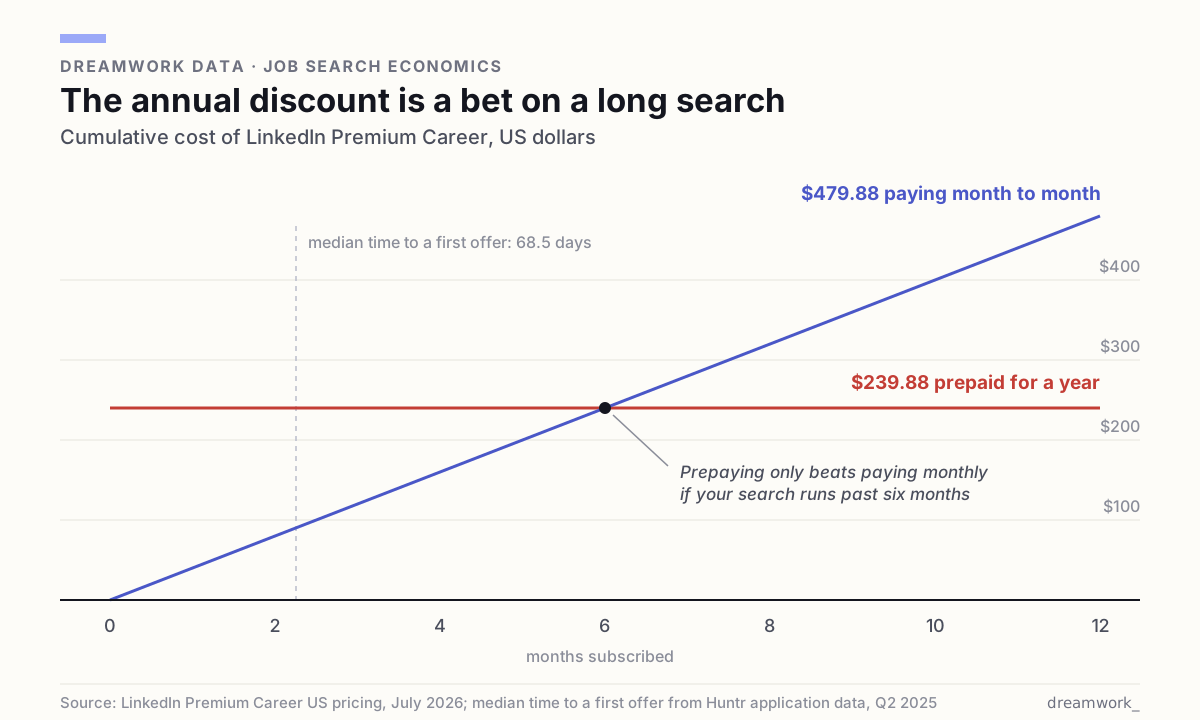
Six months is 26 weeks. The Bureau of Labor Statistics starts counting you as long-term unemployed at 27. The discount is priced, almost exactly, at the boundary of the worst outcome in a job search.
So pay monthly. As of June 2026, 1.9 million Americans — 27.3% of everyone unemployed — had been out of work 27 weeks or more, though the share of individual searches running that long is lower, because long spells pile up in any snapshot. Past six months, the annual plan wins on price and loses on what matters: the subscription is no longer your variable. Our guide to how long it takes to hear back is a better use of the next hour.
The free trial is the best part of the product
The best-value version of LinkedIn Premium is the one you don't pay for, and the mechanics are worth learning before you start the clock. All of this comes from LinkedIn's own help pages.
- The trial converts to a paid plan automatically at the end of the period unless you cancel first.
- Cancelling a free trial ends access immediately, while cancelling a paid plan keeps access to the end of the billing cycle. So don't cancel on day one — cancel one day before the billing date and use the whole trial.
- You must cancel at least one day before the next scheduled billing date to avoid the charge.
- Cancel a trial and you are ineligible for another for at least 12 months. Spend it during a real search, not a curious weekend.
- Switching plans mid-trial forfeits the trial and starts billing immediately.
- If you cancel a discounted promotional price, you cannot re-purchase that price later.
Run the month like a campaign rather than a browse: five InMails to five named humans, three Top Choice marks on three roles you genuinely want, one honest profile rewrite. If nothing moves, you have your answer and it cost you nothing but attention.
The verdict: who should buy, who shouldn't, when to cancel
Named conditions, because "it depends" is usually hiding a list somebody was too lazy to write.
Buy it if: you have a target list and can name the humans you'd message — five InMails need five addresses. You're applying to Easy Apply roles where Top Choice marks can be spent. You're senior enough that recruiter inbound is plausible, so extra visibility has somewhere to go. And you're treating it as a $40 experiment with a review date, paid monthly.
Skip it if: you have no target list, because the spendable features have nothing to point at and the dashboards change nothing. You're buying it to see who viewed your profile; that's a curiosity, not a channel. You're early in a search and short on cash, in which case an hour on referrals beats $40 every time. Or you expect it to fix a resume or targeting problem, because it touches neither. If you just want to see what's out there, browse the open roles free first.
Cancel when: you finish a month without spending your five InMails — two in a row and you're paying rent on features you don't use. When you accept an offer, remembering to send anything you were saving first, since the balance zeroes out. Or at six months: if the machine hasn't produced by then, the subscription isn't the variable worth changing.
The price was never the problem
Strip it back. Thirty-nine dollars and ninety-nine cents a month. Five messages, three flags, a dashboard. A break-even so low that tipping one search in seven hundred pays for it — and no independent evidence that it delivers even that. The company with the best data in the world on this question has never published a controlled result. That is informative, though not conclusive.
So buy it if you have somewhere to point it. Pay monthly. Set a review date and keep it. But hold on to what the arithmetic reveals, which has nothing to do with LinkedIn. About 3% of applications reach an interview, and employers see 180 applicants per hire. Premium doesn't fix that. Nothing you can buy for $40 fixes that. What it sells is a slightly shorter queue — and that a shorter queue is now a purchasable product is the clearest evidence of how long the queue has become. That's the part worth being angry about. Not the $39.99, but the market that made it look like a bargain — the problem Dreamwork was built to attack.
Frequently asked questions
How much does LinkedIn Premium cost in 2026?
As of July 2026, LinkedIn Premium Career is $39.99 a month in the US, or $239.88 prepaid for a year ($19.99 a month effective). Premium Business is $69.99 a month or $539.88 a year. Premium All-in-One is $89.99 a month. Sales Navigator Core is $119.99 a month and Advanced is $159.99. Prices exclude tax and vary by country.
Is LinkedIn Premium worth it for job seekers?
It's worth a monthly trial if you have a target list of companies and people to message, because the break-even is very low — roughly half a day off a ten-week search, or a 0.14-percentage-point lift in offer odds. It is not worth it if you have nobody to send the five monthly InMails to, since the rest of the product mostly shows you data about yourself.
Does LinkedIn Premium actually get you more interviews?
Nobody has proven it. LinkedIn claims Premium members are 2.6x more likely to get hired and 39% more likely to hear back, but those figures are its own internal data from January 2022 and are not adjusted for the fact that people who pay for job-search tools search harder. No independent study has measured Premium's effect on hiring outcomes.
Should I pay for LinkedIn Premium monthly or annually?
Monthly, almost always. The annual plan costs $239.88, which divided by the $39.99 monthly price breaks even at 5.998 months. Since the median time to a first offer is about 68.5 days, most searches end long before the prepaid year pays off. Only prepay if you are already past six months of searching.
How do I cancel the LinkedIn Premium free trial without being charged?
Cancel at least one day before your next scheduled billing date. Don't cancel on day one: cancelling a free trial ends access immediately, while cancelling a paid plan keeps access to the end of the cycle. Note that cancelling a trial makes you ineligible for another for at least 12 months, and any unused InMail balance goes to zero.
Is Sales Navigator better than Premium Career for a job search?
Not for most people. Sales Navigator Core costs $119.99 a month against Premium Career's $39.99, and the extra buys sales-prospecting search filters and 50 InMails a month instead of 5. Unless you genuinely need to message dozens of people monthly, you are paying three times as much for a tool built for a different job.
Sources
- LinkedIn — Premium Career plan page (pricing, features, and outcome claims)
- LinkedIn — Premium Business plan page (pricing and InMail credits)
- LinkedIn — Premium All-in-One plan page (pricing)
- LinkedIn Sales Navigator — Compare Pricing and Plans
- LinkedIn Help — InMail message credits and renewal process
- LinkedIn Help — Premium Top Choice Jobs
- LinkedIn Help — Use the Top Applicant feature to apply for jobs
- LinkedIn Help — Cancel LinkedIn Premium subscription FAQ
- LinkedIn Help — LinkedIn free Premium trial eligibility
- American Economic Journal: Applied Economics, 2022 — randomised evaluation of LinkedIn training
- U.S. Bureau of Labor Statistics — Usual Weekly Earnings of Wage and Salary Workers, Q2 2026
- U.S. Bureau of Labor Statistics — The Employment Situation, June 2026 (long-term unemployment)
- U.S. Bureau of Labor Statistics, Beyond the Numbers — offer rates by applications sent
- CareerPlug — 2025 Recruiting Metrics & Benchmarks Report (10M+ applications)
- The Interview Guys — State of Job Search 2025 Research Report (median time to first offer)