Mercor Review 2026: Is It Legit? How the Pay Really Works
The AI marketplace paying experts $85 an hour to train the models, and the honest math on who gets in.
Mercor is an AI-powered talent marketplace that vets experts through a 20-minute AI video interview, then pays them to train frontier AI models for labs like OpenAI and Anthropic. It is legitimate: real $10 billion backing, roughly $2 billion in annualized revenue, and about $1.5 million paid to contractors every day. But work is inconsistent, and your income depends entirely on project availability.
What Mercor actually is
For a century, the way to prove your expertise was to get hired. Mercor is a bet that the next version of work runs backwards: you prove yourself to a machine, and then you teach the machine to do what you do.
Mercor (mercor.com) is an AI talent marketplace founded in January 2023 by three college students, Brendan Foody, Adarsh Hiremath, and Surya Midha, who met on a Bay Area high-school debate team and later left Georgetown and Harvard as Thiel Fellows. It started as a way to connect engineers in India with US startups. That is not what it is anymore.
Today Mercor is the hiring layer for the AI industry itself. It recruits domain experts, PhDs, doctors, lawyers, bankers, scientists, and senior software engineers, and matches them to frontier AI labs including OpenAI, Anthropic, and Google DeepMind. These experts do not build products. They train models: writing and grading the reasoning that teaches an AI to think like a specialist, the process the industry calls reinforcement learning from human feedback. Mercor's pitch is that human judgment is the scarce fuel of better models. Its balance sheet agrees.
How it works for candidates
The front door is a form, not a recruiter. You create a profile, upload a resume, and then sit for the step that surprises most applicants: a roughly 20-minute interview conducted by an AI voice agent that reads your resume and asks specific, follow-up questions about your claimed expertise. It scores technical depth, reasoning, and how clearly you communicate. You can retake it up to three times.
- Create an account and build a profile with your resume and work history.
- Complete the AI video interview (about 20 minutes, up to 3 retakes).
- Take any role-specific skills assessment the system assigns.
- Clear work-authorization and identity checks, then join the talent pool.
- Get matched to an AI-lab project, if and when one fits your profile.
Mercor's real innovation for candidates is "apply once." Your interview results and evaluations are saved and reused across compatible roles, so qualified experts skip the repetitive screening that defines most gig platforms. Once you are on a paid project, your hours are tracked through a workforce-monitoring app, and you are paid for the time it logs.
Who actually gets paid: the real numbers
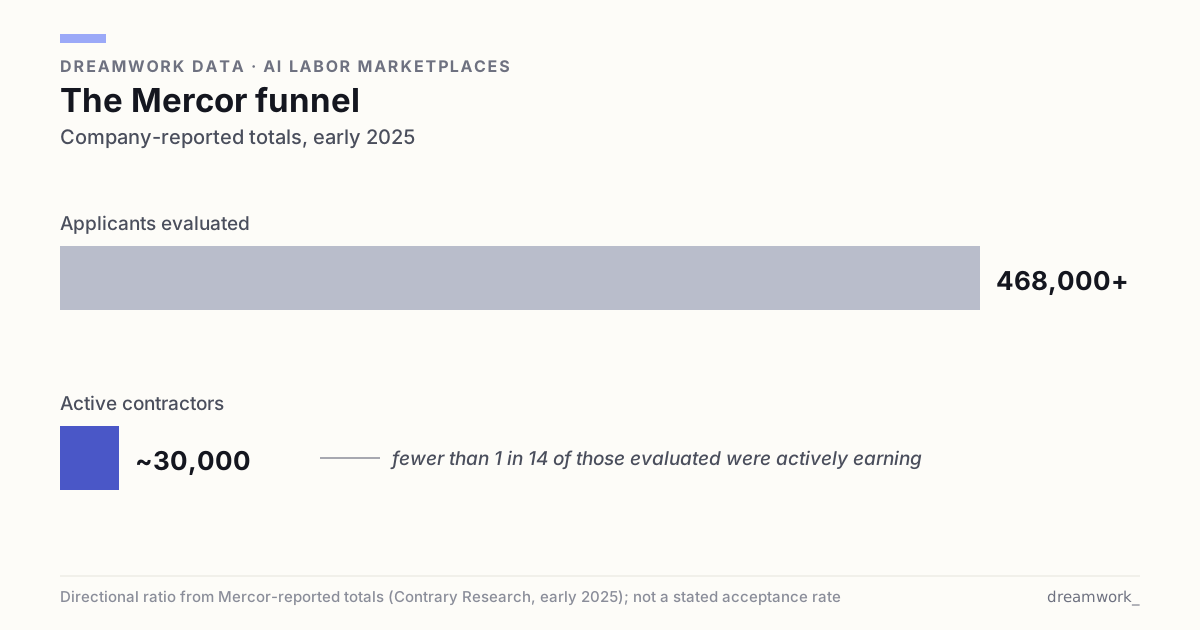
Here is where honesty matters more than the marketing. As of early 2025, Mercor said it had evaluated more than 468,000 applicants and built an active bench of about 30,000 contractors across 45-plus countries. Do the arithmetic and fewer than 1 in 14 of the people it screened were active earners. Mercor doesn't hire you to find a job. It hires you to teach the machine, and it pays only a fraction of applicants to do it.
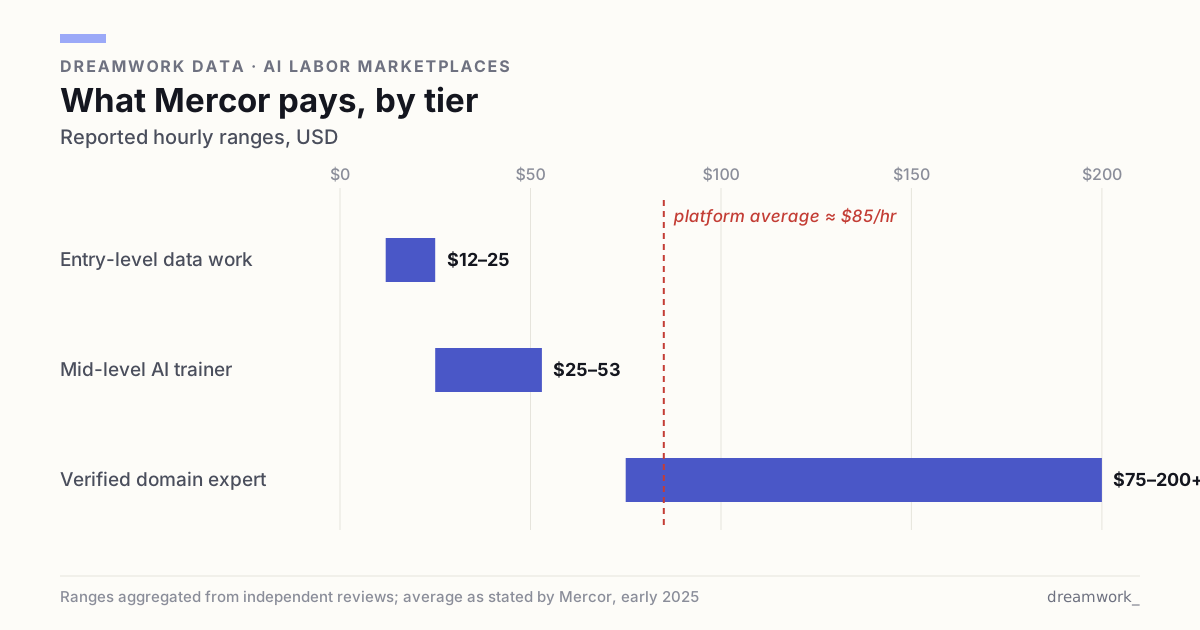
For the people who do get through, the money is real and it is good by gig-work standards. Mercor states an average of about $85 an hour across its contractors, and it says it pays out more than $1.5 million per day. Reported rates vary widely by credential and domain.
| Tier | Reported hourly range | Typical work |
|---|---|---|
| Entry-level data trainer | $12 to $25 | Basic annotation, labeling, simple review |
| Mid-level AI trainer | $25 to $53 | Structured feedback, reasoning tasks |
| Verified domain expert | $75 to $200+ | RLHF in medicine, law, finance, engineering |
Payment mechanics are consistent across independent review sites: contractors are paid weekly, generally via Stripe, for the hours their monitoring app logs. Mercor says the rate you see is the rate you get, and it takes its cut on the client side, an estimated 35% markup on hourly work and roughly 30% of first-year pay on permanent placements. Nobody is bidding against you, and no one reports being stiffed on approved hours.
The catch is not the pay rate. It is the calendar. Reviewers describe the work as "feast or famine": a lucrative project runs for weeks, then pauses or ends with little notice, and the next match may be a month away. Some contractors report accepting an offer and then waiting weeks while it sits "paused indefinitely." A high hourly rate on 10 hours of work a month is not a salary.
Is Mercor legit? The evidence
Yes. On every test that separates a real company from a scam, Mercor passes. It closed a $350 million Series C in October 2025 led by Felicis, with Benchmark, General Catalyst, and Robinhood Ventures on the cap table, at a $10 billion valuation, five times its prior round. In July 2026 it was reported to be in talks to raise another $500 million at a $20 billion valuation. It crossed roughly $2 billion in annualized revenue in June 2026 after passing $1 billion in February, and it was profitable in the first half of 2025.
The worker-side signals hold up too. Independent trackers put Mercor around 4.0 out of 5 on Trustpilot (200-plus reviews) and about 3.7 on Glassdoor, with the loudest praise reserved for on-time weekly payments. A company paying $1.5 million a day to 30,000 people is not a phantom.
So "legit" is the right word, with an asterisk. Legit means the company is real, the projects exist, and the paychecks clear. It does not mean stable. Treat Mercor as a genuine, well-funded platform that offers unpredictable income, not as an employer.
The complaints, and the controversies
The everyday gripes are consistent and fair to weigh before you apply:
- Inconsistent work: projects pause or cancel with little warning, and gaps between assignments are common.
- Opaque screening: rejections come with no feedback, so you rarely learn why the AI passed on you.
- Slow support: contractors describe communication from management as poor to non-existent.
- Constant monitoring: paid time is tracked through surveillance software, which not everyone is comfortable with.
Then there is 2026, which was a hard year for trust. In roughly late March, Mercor was hit by a supply-chain attack tied to the open-source tool LiteLLM; attackers moved through internal systems and made off with about four terabytes of data. The Lapsus$ group later claimed the breach and began auctioning the cache, and at least six contractor lawsuits allege exposure of private data including Social Security numbers. Meta paused its work with Mercor during the investigation, and other labs were reported to be reviewing theirs.
Two internal scandals surfaced alongside the hack. Mercor's leadership disclosed that an early manager on the Anthropic account had embezzled funds by enrolling his own brother and father as fake "experts" and routing them hundreds of thousands of dollars in bonus payments; the company says it recovered the money. Separately, Forbes reported that suspected North Korean operatives had used stolen credentials to pass identity checks and produce training data for American AI labs, raising the prospect that adversarial actors touched proprietary work. None of this makes Mercor a scam. All of it is a fair reason to think hard about the personal data you hand over.
Who should use Mercor, and who shouldn't
Mercor is a good fit if you are:
- A credentialed specialist, an MD, JD, PhD, quant, or senior engineer, whose expertise commands the top of the pay range.
- Looking for flexible, high-hourly side income you can pick up between other commitments.
- Comfortable with a synthetic interview, time tracking, and income that arrives in bursts.
Look elsewhere if you are:
- Counting on a steady paycheck; the feast-or-famine cycle makes Mercor a poor primary income.
- A generalist without a deep, verifiable specialty; the screen favors demonstrable expertise.
- Uneasy about workforce monitoring or handing sensitive identity data to a recently breached platform.
- Actually looking for a full-time job. Mercor sells your time to AI labs; it does not place you in a career role.
That last point is the real fork in the road. If your goal is a job, not a gig, a marketplace is the wrong shape of tool. This is the problem we built Dreamwork to solve: instead of one AI interview for one platform, an AI job search agent searches a live job index and applies to the ones that fit you.
The verdict
Mercor is a legitimate, exceptionally well-funded company that pays real experts real money to train the AI models reshaping their own professions. If you clear the interview and land a project, expect the platform average of about $85 an hour — less for entry-level data work, $200 or more for verified experts — paid weekly, and expect that project to vanish without warning. It is a strong side gig for the right specialist and a bad bet as a paycheck.
The deeper story is the one worth sitting with. A company can be worth $10 billion, be racing toward $20 billion, and still hand most of its economic upside to three founders while paying the experts by the hour and the day. That is the shape of AI-era labor in miniature, and it is the same trend we track in our AI Labor Index: the value of human judgment is rising and its bargaining power is not. Mercor pays well for the work. Read the fine print on the rest.
Frequently asked questions
Is Mercor legit?
Yes. Mercor is a real, venture-backed company valued at $10 billion (with a $20 billion round reported in talks in July 2026), earning roughly $2 billion in annualized revenue and paying out about $1.5 million to contractors daily. Independent trackers rate it around 4.0 on Trustpilot. It is legitimate, but income from it is unpredictable.
How does Mercor pay contractors?
Contractors are paid weekly, generally via Stripe, for the hours logged by a time-tracking app while they work on a project. Mercor says the advertised rate is what you receive and takes its margin from the client side. There are no widespread reports of unpaid or withheld approved hours.
Is Mercor free to join?
Yes. Creating a profile, taking the AI interview, and joining the talent pool cost nothing. Mercor makes money by marking up your rate to the AI labs (an estimated 35%), not by charging you. Be wary of any site that asks you to pay to work for Mercor.
What is the Mercor interview like?
It is a roughly 20-minute one-way video interview conducted by an AI voice agent. It reads your resume and asks specific, follow-up questions about your expertise, scoring technical depth, reasoning, and communication. You can retake it up to three times, and your results are reused across roles.
How much can you actually make on Mercor?
Rates run from about $12 to $25 an hour for basic data work up to $75 to $200-plus for verified domain experts, with a platform-wide average near $85. Real monthly earnings vary wildly because work is feast-or-famine: a busy month can be lucrative, and the next may bring no projects at all.
Mercor vs. traditional job boards: what's the difference?
A job board lists openings you apply to for a normal role. Mercor is a marketplace that vets you once, then matches you to short-term AI-training gigs for labs like OpenAI and Anthropic. It is closer to specialized freelance work than employment. If you want a full-time job rather than gig income, a board or an application agent is the better fit.
Sources
- TechCrunch: Mercor quintuples valuation to $10B with $350M Series C
- Forbes: Mercor in talks to raise $500M at $20B valuation
- Forbes: Mercor founders grapple with employee fraud and North Korean infiltration
- Contrary Research: Mercor business breakdown and founding story
- RemoWork: Mercor review, how it works, pay and is it worth it (2026)
- GigDrift: Mercor review 2026, is it legit, pros and cons
- TalentsForAI: Is Mercor legit? An honest warning before you apply